
How to Refactor Legacy Code Without a Risky Rewrite
The old code still makes money, but every change feels dangerous. Here is how to refactor legacy code step by step, without betting the business on a rewrite.
 AivoPass Editorial TeamReviewed by our agent setup specialists
Updated
Reading time5 min

To refactor legacy code without a rewrite, find the risky areas that change most, add tests that lock in current behaviour, then improve one small area at a time with changes that are easy to review and undo. Nightly Code Auditor reviews your whole codebase overnight and prepares one focused cleanup per area for your team to review each morning.
Every growing business has some: the old booking module, the invoice code written by a contractor who left, the file nobody wants to open. It still makes money, but every change feels dangerous. The tempting answer is a complete rewrite. The safer answer, for most teams, is to refactor legacy code steadily, one small area at a time, while the product keeps running.
This guide explains why rewrites go wrong, how to map the risky areas, how to add safety tests and how to make small changes your team can trust. It also shows how Nightly Code Auditor reviews your whole codebase overnight and prepares one focused cleanup per area for your team to review each morning.
See Nightly Code Auditor Done-for-you setup · You approve every action
What does it mean to refactor legacy code?
Refactoring legacy code means improving the internal structure of older software without changing its behaviour for users. Names get clearer, long functions get split, duplicated logic is merged and dead code is removed. The product works the same, but the next change becomes faster and safer.
Why full rewrites so often go wrong
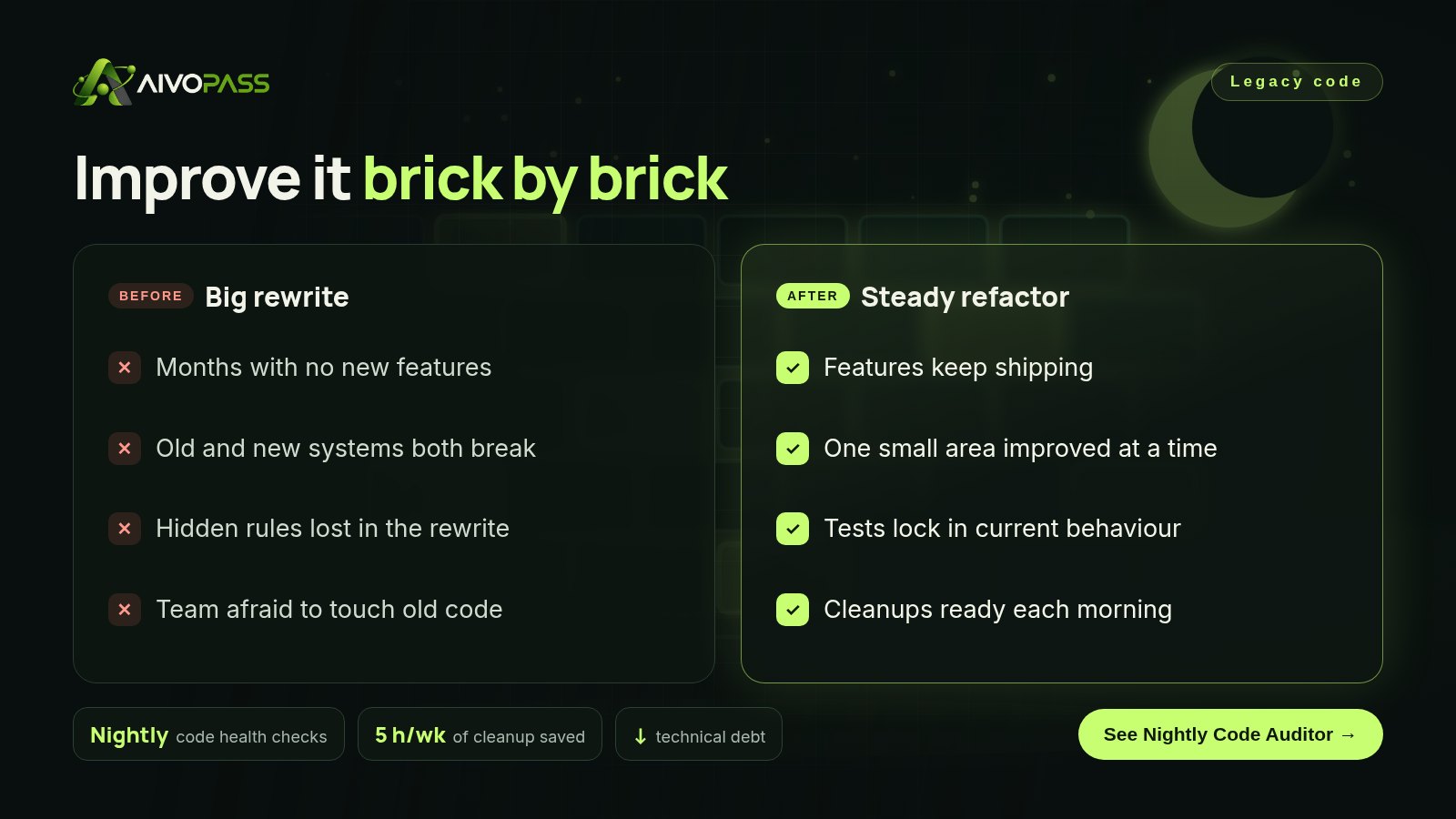
- Hidden rules get lost: years of small fixes encode business rules nobody documented.
- Two systems to maintain: the old one still needs fixes while the new one is built.
- No new features for months: customers and sales feel the pause.
- Deadlines slip: the “three-month rewrite” becomes a year.
Rewrite or refactor? A quick decision table
| Situation | Better choice | Why |
|---|---|---|
| Code works but is hard to change | Refactor | Keep value, reduce risk step by step |
| Technology is no longer supported | Gradual replacement | Move one piece at a time |
| Small, isolated tool | Rewrite can be fine | Low risk and short timeline |
| Core revenue system | Refactor | Downtime and lost rules are too costly |
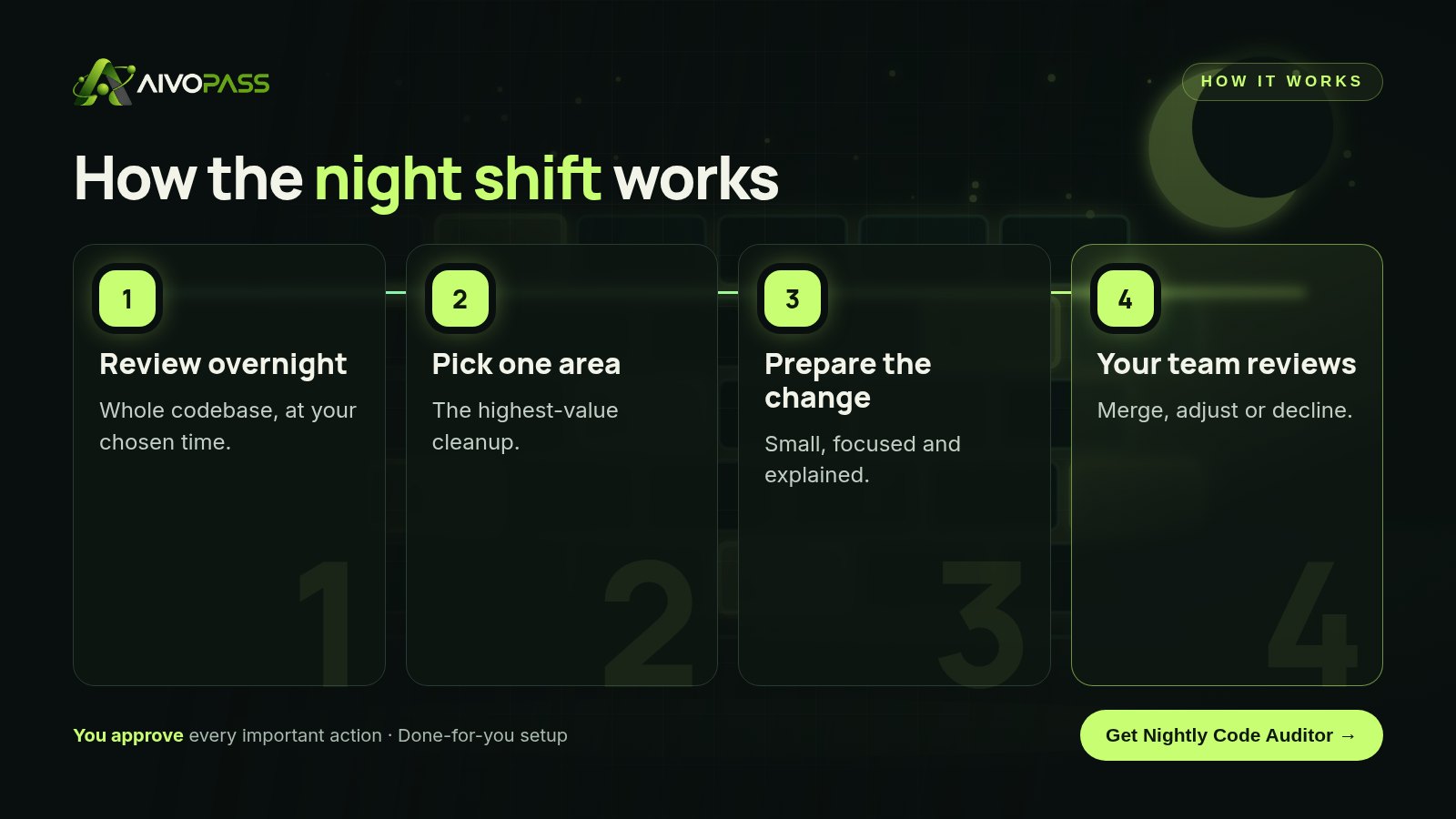
How Nightly Code Auditor works
- Full codebase review every night at a time you choose.
- One focused cleanup per area, not a giant change.
- Changes prepared for review with a short explanation.
- Scheduled at your preferred time, so it never gets in the way.
Before and after
| Moment | Without steady refactoring | With Nightly Code Auditor |
|---|---|---|
| Monday morning | Cleanup is “someday” | Focused changes waiting for review |
| Touching old code | Fear and long testing | Smaller, clearer files |
| Planning | Rewrite debates | Progress visible every week |
| New developer joins | Weeks to understand | Cleaner, better-named code |
A safe, step-by-step method
- Map the hot spots: files that change most and cause most bugs.
- Add safety tests: lock in what the code does today before you change it.
- Change one area at a time: small changes are easy to review and undo.
- Replace gradually: wrap old parts and move features over piece by piece.
- Delete dead code: unused code is still code someone must understand.
- Repeat weekly: steady progress beats an occasional heroic sprint.
Who it is for
Technical founders
A founder in Victoria still writes much of the code for a booking platform and never finds time for cleanup.
Small software teams
A four-developer team in Ottawa supports a ten-year-old system and wants to improve it without stopping features.
Agencies maintaining client systems
A development agency in Edmonton inherits old client projects and needs to make them safe to change.
Results to expect
These figures are typical estimates, not guarantees. Results depend on your codebase, tests and how often the team reviews the prepared changes.
Example: a booking platform in Victoria
A small company running online bookings for tour operators had a ten-year-old scheduling module that nobody wanted to touch. The founder had planned a rewrite twice and cancelled it twice. Instead, they connected Nightly Code Auditor and set it to run at 2 a.m. Pacific time. Each morning the team found one or two small, explained changes: a duplicated date calculation merged, a 600-line function split into clear steps, unused payment code removed after confirming it was never called. The team approved most of them, adjusted a few and declined some. After two months, a feature that used to take two weeks in that module took three days.
Mistakes to avoid
- Changing behaviour and structure in the same change.
- Refactoring without any tests around the area.
- Starting with the code that never changes, instead of the hot spots.
- Making huge changes nobody can review properly.
- Treating cleanup as a one-time project.
Safety and control
- It never merges on its own; every change is reviewed by your team.
- Each change is small, focused and easy to undo.
- It uses only the repository access you grant.
- Runs happen at the time you choose.
- You can pause it or remove access at any time.
Nightly Code Auditor vs alternatives
| Option | Keeps features shipping | Risk | Effort for you |
|---|---|---|---|
| Big rewrite | No | High | Months of focus |
| Occasional cleanup sprint | Pauses them | Medium | A sprint each time |
| Outside contractor | Usually | Medium | Handover and oversight |
| Nightly Code Auditor | Yes | Low, small reviewed changes | Morning reviews |
How setup works
- Choose Nightly Code Auditor and check out securely.
- Connect your code repository with limited access.
- Choose your nightly time and the areas to focus on; we test the first run with you.
- Go live: focused cleanups waiting for review every morning.
Related agents
Combine it with a software engineer agent, an engineering lead or a release QA checker. Browse all engineering AI agents or read more engineering guides.
The bottom line
You do not need to bet the business on a rewrite. Map the hot spots, add safety tests and improve one small area at a time. Nightly Code Auditor does the patient part overnight, so your team wakes up to cleaner code and keeps shipping.
Get Nightly Code Auditor Nightly review · Small focused changes · Your team decides
Frequently asked questions
What does it mean to refactor legacy code?
It means improving the structure of older code without changing what it does for users, so it becomes easier and safer to change.
Should I rewrite or refactor?
Refactor in most cases. A rewrite only makes sense when the technology is truly unsupported or the product is small. Steady refactoring keeps the business running while the code improves.
Does Nightly Code Auditor change my code directly?
No. It prepares one focused cleanup per area as a change for review. Your team decides whether to merge, adjust or decline it.
What does it need?
Access to your code repository and a time window for the nightly run. Access can be limited and removed at any time.
Is it only for large codebases?
No. Small teams and technical founders benefit most, because they rarely have spare time for cleanup.
See Nightly Code Auditor in action.
Reviews your whole codebase overnight and prepares one cleanup change per area for your review. Runs at a time you choose.
We are the people who set up, connect and support AivoPass agents for businesses across Canada and beyond. Every guide is written from real setup work, reviewed by our specialists and updated when an agent changes.
- ✓ Done-for-you setup
- ✓ You approve every important action
- ✓ Secure PayPal checkout
- ✓ Built for Canadian businesses


