Competitor Onboarding Teardown: How to Learn From Their First Five Minutes
The fastest way to understand a competitor is to sign up like a customer. Here is how to run a competitor onboarding teardown and turn it into real improvements.
 AivoPass Editorial TeamReviewed by our agent setup specialists
Updated
Reading time5 min

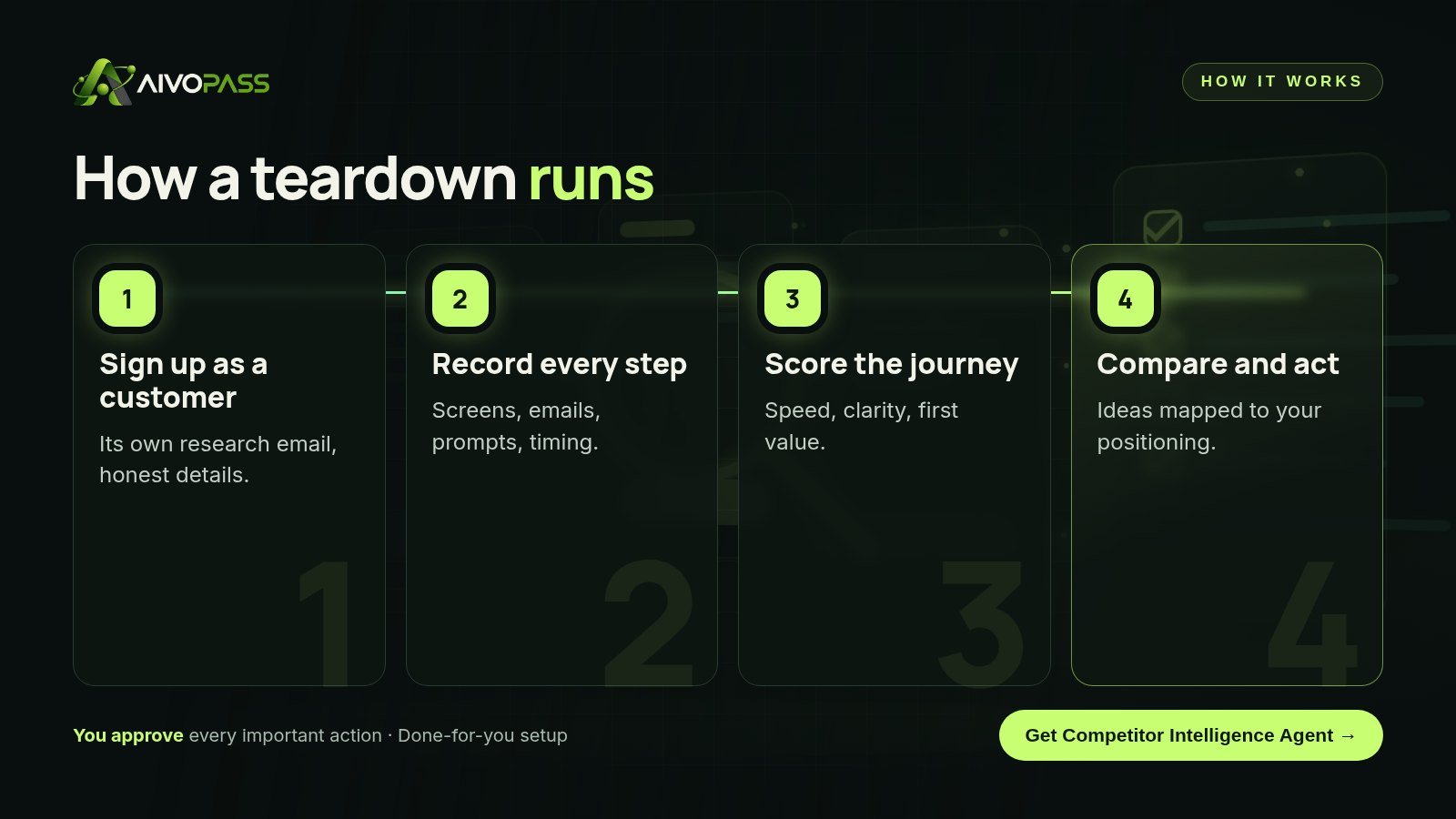
A competitor onboarding teardown means signing up for a rival product as a normal customer and recording every step from sign-up to first value: questions asked, emails sent, empty screens and upgrade prompts. Competitor Intelligence Agent does this with its own research email, repeats it when things change and compares each finding with your positioning.
Most owners know their competitors from a home page, a sales call or a rumour from a customer. Very few have actually signed up and walked through the product the way a new customer does. A competitor onboarding teardown closes that gap. In about an hour you learn what your rival asks for, how fast they deliver the first win and how hard they push for an upgrade.
This guide shows what to record, how to score it and how to turn findings into changes in your own onboarding. It also shows how Competitor Intelligence Agent signs up with its own research email, records each step, watches for changes and compares everything with your positioning in a weekly report.
See Competitor Intelligence Agent Done-for-you setup · You approve every action
What is a competitor onboarding teardown?
A competitor onboarding teardown is a step-by-step record of a rival product’s first-run experience, from the sign-up form to the moment a new user gets real value. It captures screens, questions, emails, empty states and upgrade prompts, then scores them for speed and clarity. The goal is not to copy, but to understand their strategy and sharpen yours.
Why the first five minutes tell you so much
- Who they want: the fields on the sign-up form show which customers they are chasing.
- What they think matters: the first task they guide you to is the value they believe sells.
- How they convert: trial length, reminders and upgrade prompts reveal their sales model.
- Where they are weak: confusing steps and empty screens are openings for you.
What to record, step by step
- Sign-up form: number of fields, required details, social sign-in options, any phone or card requests.
- Welcome screen: the first message and the first action suggested.
- Setup questions: role, company size, goals and how answers change the product.
- Empty states: what you see before you add any data, and whether sample data is offered.
- Time to first value: minutes until something genuinely useful happens.
- Emails and nudges: every message in the first two weeks, with timing and subject line.
- Upgrade moments: where limits appear and how the upgrade is presented.
- Help and support: chat, guides and how quickly a question is answered.
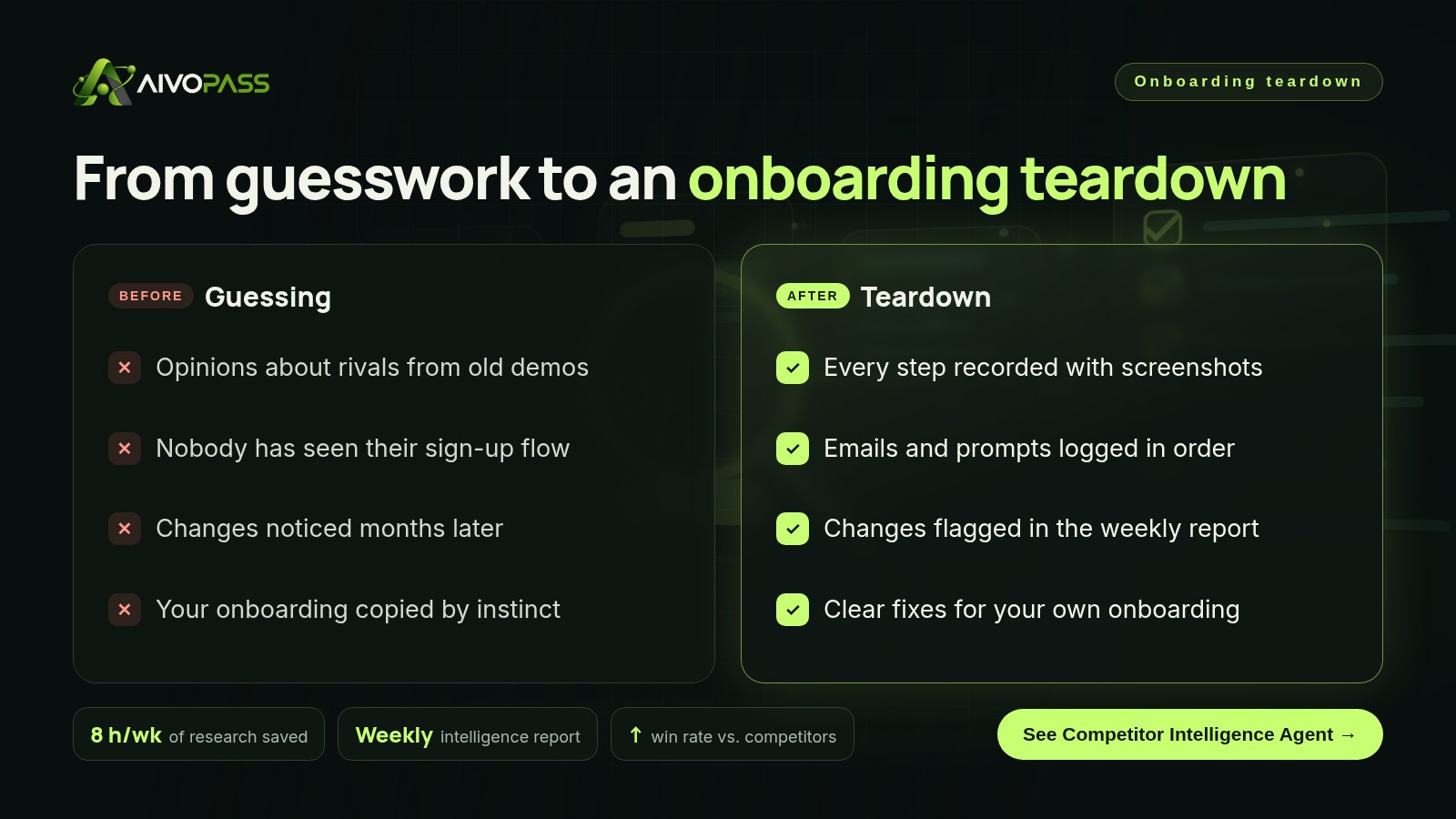
Before and after a teardown habit
| Question | Without teardowns | With Competitor Intelligence Agent |
|---|---|---|
| How do rivals onboard? | Guessed from old demos | Recorded with screenshots |
| What emails do they send? | Unknown | Logged in order with timing |
| Did their flow change? | Noticed months later | Flagged in the weekly report |
| What should we change? | Debated without evidence | Ideas tied to your positioning |
A simple teardown scoring sheet
| Area | What to score (1 to 5) | Tip |
|---|---|---|
| Sign-up effort | Fields, steps, verification | Fewer is not always better if questions personalise setup |
| First value | Minutes to a real result | Write down the exact moment it happened |
| Guidance | Clarity of the next step | Note any moment you felt lost |
| Follow-up | Usefulness of emails | Helpful tips beat generic reminders |
| Upgrade pressure | How and when limits appear | Early hard walls often signal a sales-led model |
Who it is for
Software founders
A two-person software company in Waterloo wants to know why prospects pick a larger rival after a trial.
Product and marketing teams
A product team in Montreal needs evidence before redesigning its own welcome flow, in English and French.
Service businesses with online sign-up
A booking platform for clinics in Vancouver wants to see how rivals handle the first appointment set-up.
Results to expect
These figures are typical estimates, not guarantees. Results depend on your market, your competitors and how you act on the findings.
Example: an HR software company in Waterloo
A small company selling scheduling software to restaurants kept losing trials to a bigger rival. The founder assumed the rival simply had more features. The agent signed up to the rival’s trial with its own research email and recorded the flow. The rival asked only three questions, loaded a sample week of shifts for a restaurant and sent a short video email the next morning showing how to publish the first schedule. The founder’s own product asked eleven questions and opened on an empty calendar. Within two weeks the team cut its form, added a sample schedule and wrote a next-day email. The weekly report later flagged when the rival added a new step, so the team could see whether it helped or hurt them.
How to turn findings into fixes
- Pick the one moment where the rival delivers value faster than you, and fix that first.
- Do not copy screens. Copy the principle, such as sample data or a guided first task.
- Rewrite your welcome email around the first win, not a feature list.
- Use differences in your sales conversations: show prospects what you do better.
- Repeat the teardown after your change to compare both flows side by side.
Mistakes to avoid
- Doing one teardown and never repeating it.
- Recording screens but ignoring follow-up emails.
- Judging only design and forgetting time to first value.
- Pretending to be someone you are not on sales calls.
- Sharing findings in a long document nobody reads.
Safety and ethics
- It uses only public sign-up pages and public information.
- It uses its own research email, never your customers’ details.
- It does not misrepresent itself in conversations or try to access private data.
- It respects the terms of sites and products it uses.
- You decide what changes to make; you can pause or stop it at any time.
Competitor Intelligence Agent vs alternatives
| Option | Repeats automatically | Tracks changes | Effort for you |
|---|---|---|---|
| One-off teardown by the founder | No | No | Hours each time |
| Staff screen recordings | Rarely | Partly | Ongoing staff time |
| Outside research firm | On request | In each project | Briefing and waiting |
| Competitor Intelligence Agent | Yes | Yes, weekly | Reading a report |
How setup works
- Choose Competitor Intelligence Agent and check out securely.
- List your competitors and describe your positioning.
- We set up its research email, run the first teardown and test the report.
- Go live: a weekly report with onboarding changes and counter-positioning ideas.
Related agents
Pair it with a competitor website watcher, an idea stress test or a product spec writer. Browse all product AI agents or read more product guides.
The bottom line
Your prospects try your competitors before they decide. You should know exactly what they see. A regular competitor onboarding teardown shows you where rivals win the first five minutes, and Competitor Intelligence Agent keeps that picture current without taking your week.
Get Competitor Intelligence Agent Weekly report · Onboarding recorded · You decide every change
Frequently asked questions
What is a competitor onboarding teardown?
It is a structured walk-through of a rival product from sign-up to the first useful result, recorded step by step so you can see what they ask, show and send to new customers.
Is it ethical to sign up for a competitor product?
Signing up through a public sign-up page, as any prospect could, is a common research practice. Do not misrepresent who you are in conversations, do not break terms you agree to and never try to access private data.
How often should I repeat a teardown?
Once a quarter for your main rivals, and again whenever they announce a redesign or new plan. The agent watches for changes so you know when a fresh look is worth it.
Does the agent send anything in my name?
No. It uses its own research email for sign-ups and reports back to you. Any change to your own product or messaging is your decision.
What do I need to get started?
A list of the competitors you care about and a short description of your positioning. Setup and testing are done for you.
See Competitor Intelligence Agent in action.
Signs up for competitors’ newsletters and products with its own research email, records their onboarding and watches their site, pricing, changelog and hiring. Each report compares changes to your positioning.
We are the people who set up, connect and support AivoPass agents for businesses across Canada and beyond. Every guide is written from real setup work, reviewed by our specialists and updated when an agent changes.
- ✓ Done-for-you setup
- ✓ You approve every important action
- ✓ Secure PayPal checkout
- ✓ Built for Canadian businesses