
7 Competitive Intelligence Myths That Keep Small Businesses Guessing
Many owners think competitive intelligence is expensive, shady or only for big companies. Here are seven myths, the facts behind them and a simple weekly routine any small team can follow.
 AivoPass Editorial TeamReviewed by our agent setup specialists
Updated
Reading time5 min

Competitive intelligence for small business means regularly and ethically tracking what competitors publicly offer, change and promote, then using it to sharpen your own positioning. Competitor Intelligence Agent signs up to competitor products and newsletters with its own research email, records onboarding, watches public changes and sends a weekly report with counter-positioning ideas.
Ask a small business owner about competitors and you usually hear one of two things: “I don’t have time to watch them” or “I check their website now and then.” Both leave money on the table. Competitive intelligence for small business is not a luxury or a dark art; it is a simple habit, and most of what stops owners is a handful of myths.
Below are seven of them, the facts behind each and a routine you can follow. We also show how Competitor Intelligence Agent does the watching for you, ethically, and turns it into a weekly report with ideas to respond.
See Competitor Intelligence Agent Done-for-you setup · You approve every action
What is competitive intelligence?
Competitive intelligence is the ongoing, ethical collection of public information about competitors, such as their offers, onboarding, product updates and hiring, and turning it into decisions about your own positioning. The goal is not to copy anyone; it is to know where you stand and where you can win.
Seven myths, and the facts
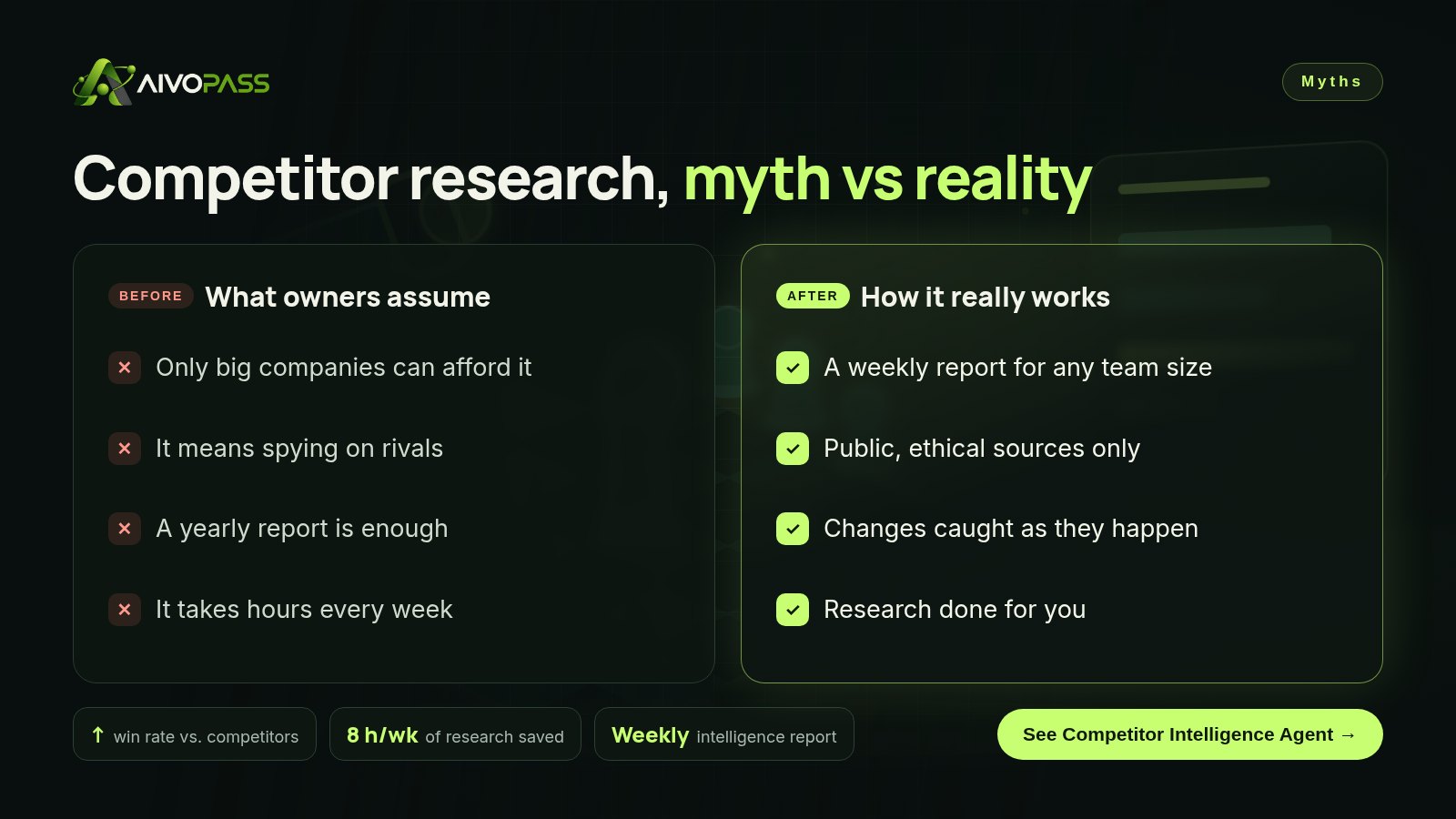
Myth 1: It is only for big companies
Fact: big companies have research teams, but small businesses feel the impact of a competitor’s move faster. A new offer from a rival down the street, or a new feature from a competitor in your niche, can change your month.
Myth 2: It means spying
Fact: good competitive intelligence uses only public sources and normal customer experiences: newsletters, free trials, websites, changelogs and job posts. No pretending, no hacking, no confidential data.
Myth 3: A yearly review is enough
Fact: competitors change messages, onboarding and offers far more often than once a year. A weekly rhythm catches changes while you can still respond.
Myth 4: Their website tells you everything
Fact: the most revealing details are inside the experience: what the welcome emails promise, how onboarding works, which features they push first. You only see that by signing up.
Myth 5: It takes hours every week
Fact: doing it by hand does. Delegating the watching means you spend minutes reading a report instead of hours clicking through sites.
Myth 6: Knowing more about rivals makes you a copycat
Fact: knowing what everyone else says is how you find a message nobody else owns. Intelligence helps you differentiate, not imitate.
Myth 7: There is nothing to act on
Fact: every good report ends with actions: a sales talking point to update, a page to rewrite, a feature to highlight. If a report has no actions, it is a news feed, not intelligence.
What Competitor Intelligence Agent does
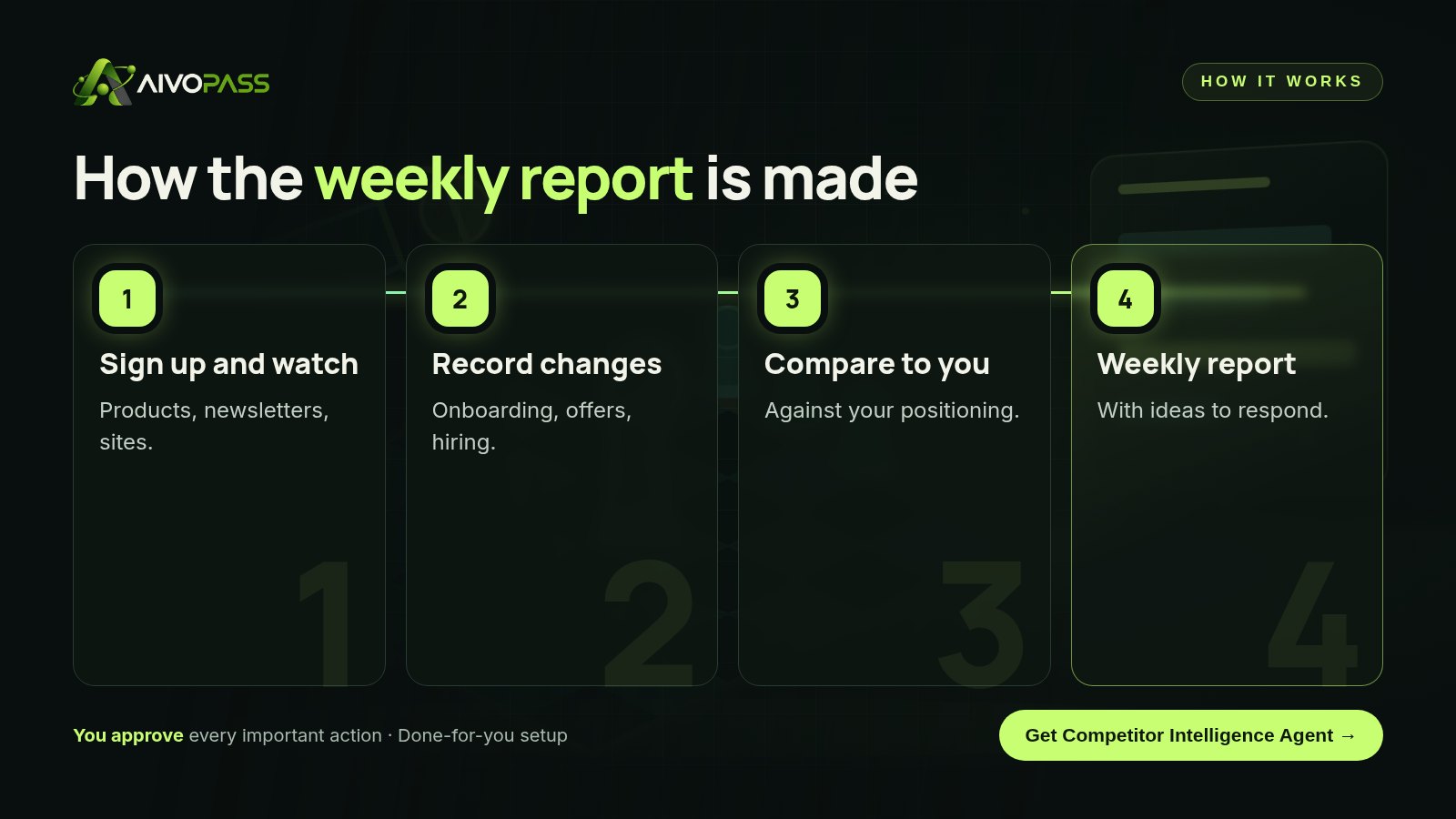
- Signs up to competitor products and newsletters with its own research email.
- Records onboarding flows, so you see the experience their new customers get.
- Tracks public changes to offers and plans, product changelogs and hiring.
- Suggests counter-positioning ideas in each weekly report, compared with your own positioning.
Before and after
| Area | Occasional checking | With Competitor Intelligence Agent |
|---|---|---|
| Frequency | When someone remembers | Every week, on schedule |
| Depth | Homepage only | Onboarding, emails, changelog, hiring |
| Time spent | Hours of clicking | About eight hours saved weekly, typical estimate |
| Output | Scattered notes | One report with actions |
| Sales conversations | Outdated talking points | Fresh comparisons for reps |
Who it is for
Founders of growing software companies
A SaaS founder in Vancouver had four direct competitors and no time to follow them. The weekly report flagged a rival’s new onboarding promise, and her team updated their own welcome emails within days.
Marketing leads at service businesses
A marketing manager at a Toronto accounting firm used the reports to spot gaps in competitors’ messages to small businesses and built a campaign around them.
Product teams deciding what to build next
A product lead in Montreal used changelog tracking to see where competitors were investing, then focused on the problems they kept ignoring.
Results to expect
These figures are typical estimates, not guarantees. The value depends on how many competitors you track and how quickly you act on the ideas.
An ethics checklist for competitor research
- Use public pages and normal sign-ups only.
- Never pretend to be a specific real customer or employee.
- Never ask competitor staff for confidential information.
- Respect terms of use and unsubscribe when you stop tracking.
- Use what you learn to improve your offer, not to mislead.
A one-hour weekly routine
| Time | Task | Outcome |
|---|---|---|
| 15 minutes | Read the weekly report | Know what changed |
| 15 minutes | Pick one change that affects you | A clear focus |
| 20 minutes | Update one page, email or talking point | A visible response |
| 10 minutes | Share key points with sales and support | A team that is up to date |
Safety and control
- Research uses a dedicated email, never your personal or company accounts.
- Only public information and normal sign-ups are used.
- You choose which competitors are tracked.
- Reports are private to your team.
- You can pause or stop tracking at any time.
Competitor Intelligence Agent vs alternatives
| Option | Sees inside onboarding | Weekly rhythm | Ideas to respond |
|---|---|---|---|
| Doing it yourself | If you find time | Rarely | Sometimes |
| One-off consultant report | Sometimes | No, a snapshot | Yes, once |
| Website change alerts | No | Yes | No |
| Competitor Intelligence Agent | Yes | Yes | Yes, in every report |
How setup works
- Choose Competitor Intelligence Agent and check out securely.
- Share your competitor list and a short description of your positioning.
- We set up the research email, start tracking and review the first report with you.
- Go live: a weekly report arrives with changes and ideas to respond.
Related agents
Get quick alerts on competitor changes, research trends from the last 30 days or stress-test a new idea before you build it. Browse all product AI agents or read more product guides.
The bottom line
Competitive intelligence for small business is not about spying or big budgets. It is about knowing, every week, what your competitors changed and what you will do about it. Drop the myths, keep it ethical and let Competitor Intelligence Agent do the watching so you can focus on winning.
Get Competitor Intelligence Agent Ethical research · Weekly report · Ideas to respond
Frequently asked questions
What is competitive intelligence for small business?
It is the regular, ethical tracking of what competitors publicly offer, change and promote, so you can adjust your own message, product and offers with facts instead of guesses.
Is competitive intelligence legal and ethical?
Yes, when it uses public information and normal customer experiences, such as signing up to a newsletter or a free trial. It never involves hacking, pretending to be someone else or taking confidential information.
How does Competitor Intelligence Agent collect information?
It uses its own research email to sign up to competitor newsletters and products, records the onboarding experience and watches public pages, changelogs and job posts.
How often do I get updates?
You receive a weekly intelligence report that compares changes to your own positioning and suggests ideas to respond.
Is it worth it for a small team?
Small teams benefit most, because they rarely have time for regular research. The agent does the watching and you spend minutes reading the report.
See Competitor Intelligence Agent in action.
Signs up for competitors’ newsletters and products with its own research email, records their onboarding and watches their site, pricing, changelog and hiring. Each report compares changes to your positioning.
We are the people who set up, connect and support AivoPass agents for businesses across Canada and beyond. Every guide is written from real setup work, reviewed by our specialists and updated when an agent changes.
- ✓ Done-for-you setup
- ✓ You approve every important action
- ✓ Secure PayPal checkout
- ✓ Built for Canadian businesses