
Sales Qualification Frameworks Compared: BANT, MEDDIC and a Simple Version for Small Teams
BANT, MEDDIC, CHAMP: every sales book has a framework. Here is how the main sales qualification frameworks compare, and which one a small team should actually use.
 AivoPass Editorial TeamReviewed by our agent setup specialists
Updated
Reading time4 min

A sales qualification framework is a short list of questions every deal must answer before it moves forward, such as need, decision maker, timing and budget. BANT suits simple sales, MEDDIC suits complex ones and small teams often do best with five plain questions. Deal Inspector checks each deal against your chosen criteria using quotes from real call transcripts.
Every sales team says it qualifies deals. Yet most pipelines are full of opportunities that never had a real decision maker, timeline or problem worth solving. Choosing a sales qualification framework is the first step. Using it honestly, with evidence instead of memory, is the step most teams miss.
This guide compares the best-known frameworks in plain English, suggests a simple version for small teams and shows how to make the framework stick. It also explains how Deal Inspector checks every deal that changes stage against your criteria, quoting real call transcripts as evidence.
See Deal Inspector Done-for-you setup · You approve every action
What is a sales qualification framework?
A sales qualification framework is a short, shared checklist that decides whether a deal deserves more time. It asks the same questions of every opportunity, such as whether there is a real need, a decision maker and a timeline. The value comes from consistency: everyone judges deals the same way, so the pipeline means something.
The main frameworks side by side
| Framework | What it checks | Best for |
|---|---|---|
| BANT | Budget, authority, need, timing | Short, simple sales |
| CHAMP | Challenges, authority, money, prioritisation | Problem-led conversations |
| MEDDIC | Metrics, economic buyer, decision criteria, decision process, pain, champion | Larger deals with several people involved |
| Simple five questions | Problem, owner, deadline, next step, risk | Small teams starting out |
A simple five-question version for small teams
- Problem: what pain did the customer describe in their own words?
- Owner: who decides, and have we spoken to them?
- Deadline: what event makes this urgent?
- Next step: is there a dated next meeting or action?
- Risk: what could stop this deal, such as a competitor or a freeze on spending?
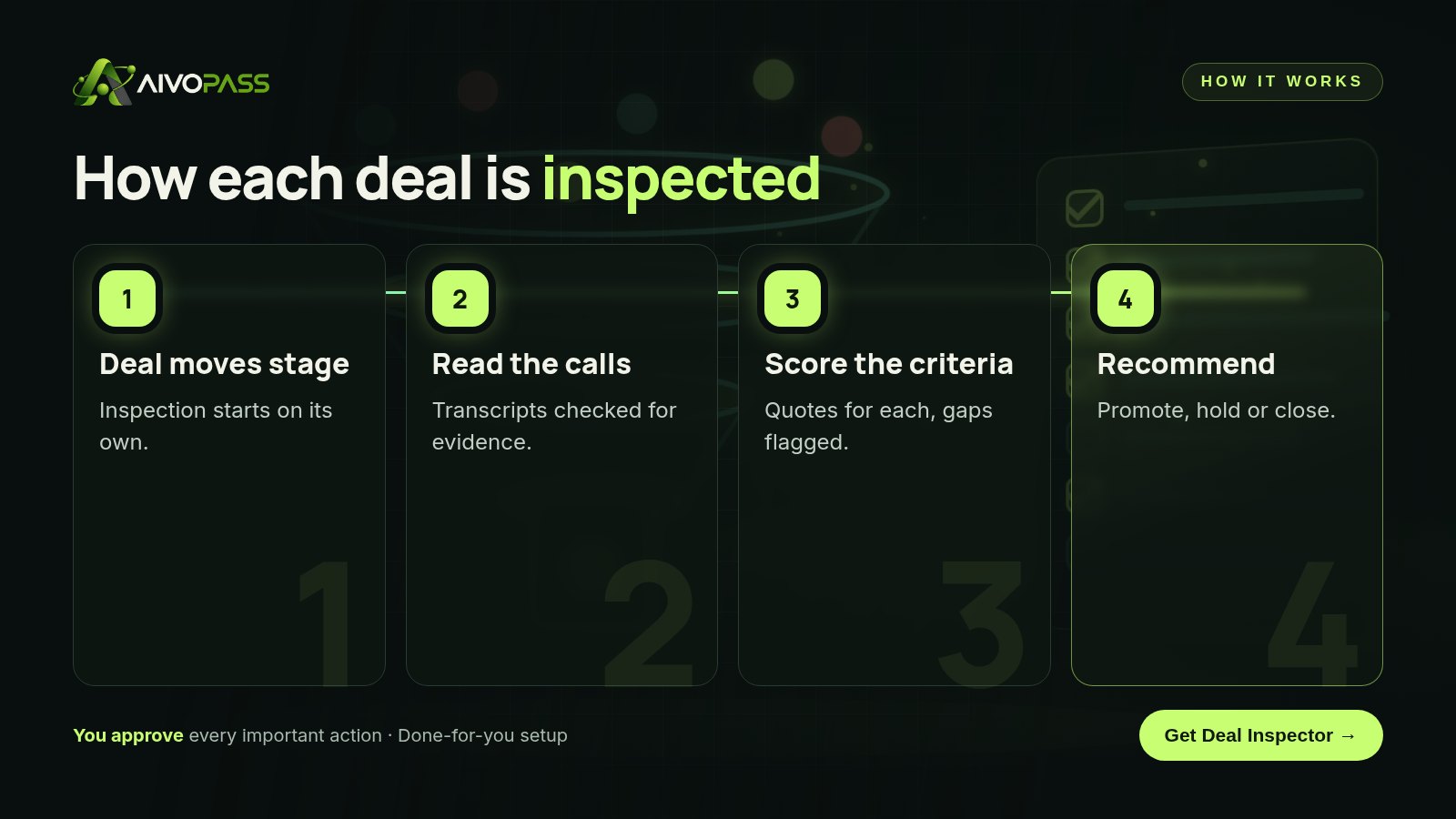
How Deal Inspector applies your framework
- Checks deals against your criteria whenever they move stage.
- Quotes evidence from calls for each criterion.
- Flags missing qualification before the deal goes further.
- Recommends the next stage: promote, hold or close.
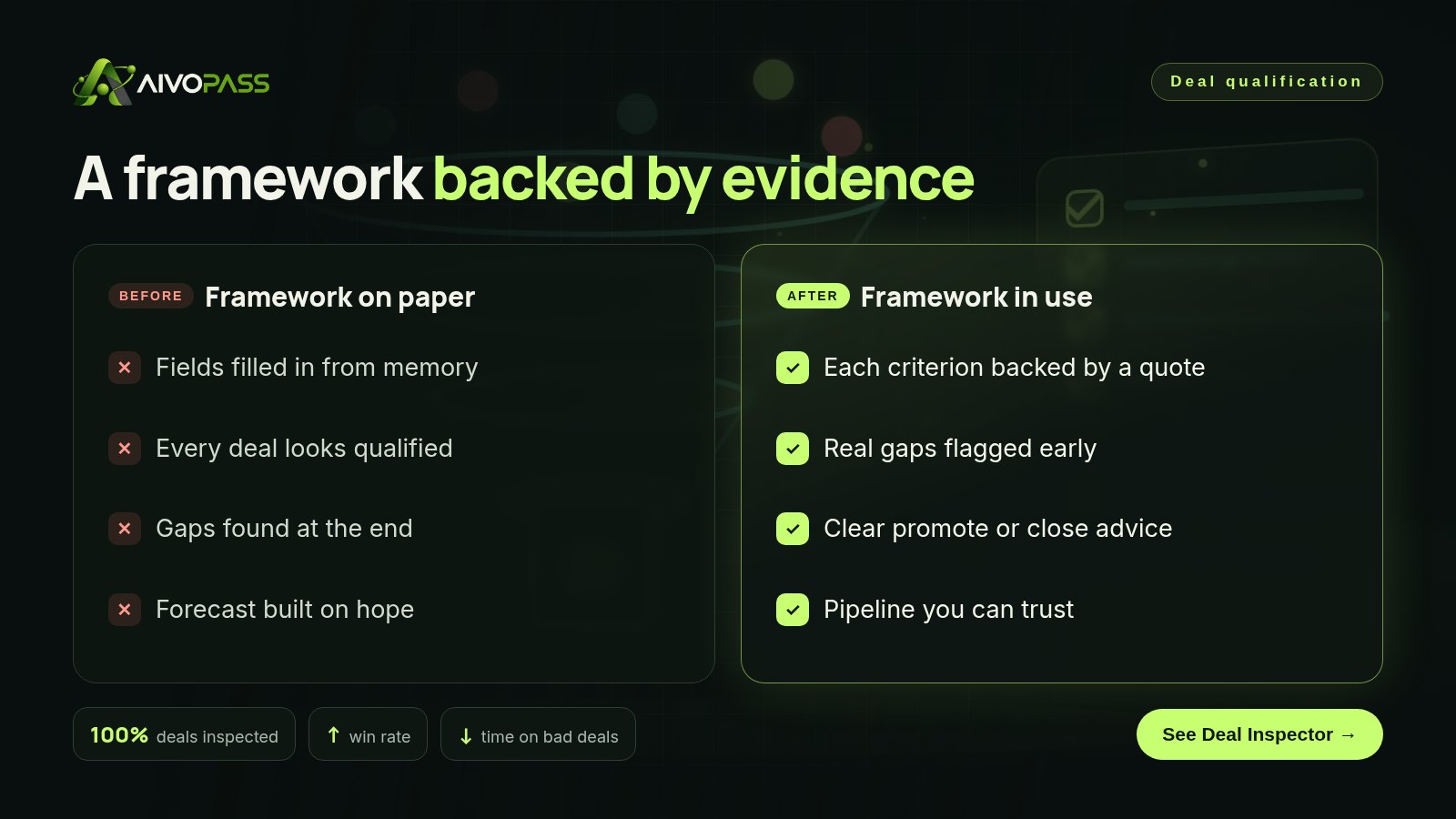
Before and after evidence-based qualification
| Moment | Framework on paper | With Deal Inspector |
|---|---|---|
| Deal moves to proposal | Rep ticks the boxes | Each box backed by a call quote |
| Decision maker | “I think it is the CEO” | Flagged: never on a call |
| Pipeline review | Long debates | Focused on flagged gaps |
| Quarter end | Surprise losses | Weak deals closed or fixed earlier |
Who it is for
Small B2B sales teams
A three-rep team selling software to clinics in Ottawa wants every deal judged the same way.
Sales managers
A sales manager in Toronto wants to spend pipeline reviews coaching, not interrogating.
Distributors and industrial suppliers
An equipment distributor in Mississauga needs to know which large quotes are real before ordering stock.
Results to expect
These figures are typical estimates, not guarantees. Results depend on your sales process, data quality and how the team acts on the findings.
Example: an equipment distributor in Mississauga
A distributor of food processing equipment adopted BANT but saw little change: reps filled in the four fields from memory and almost every deal looked qualified. They switched to the simple five-question version and connected Deal Inspector to their CRM and call transcripts. In the first month, it flagged that a third of proposal-stage deals had never included the person who signs. For each one it quoted the call where the contact said “I will need to run this past the owner”. Managers used the flags to ask for a meeting with the owner or to close the deal early. Pipeline reviews became shorter and more focused.
How to write criteria an outsider could check
- Replace “budget confirmed” with “customer said what they plan to spend or the approval process”.
- Replace “decision maker engaged” with “the person who signs attended at least one call”.
- Replace “urgent” with “a dated event that makes this time-sensitive”.
- Keep each criterion to one sentence.
- Agree what counts as evidence: a quote, an email or a meeting.
Mistakes to avoid
- Choosing a complex framework for a simple sale.
- Letting reps self-report without evidence.
- Qualifying once and never again as deals change.
- Keeping weak deals to make the pipeline look full.
- Changing criteria every quarter so nothing can be compared.
Safety and control
- It recommends; your team decides on every deal.
- It uses only the CRM and call data you connect.
- Every finding comes with a quote you can check.
- Access is limited and can be removed at any time.
- Call recording and transcripts should follow your consent practices and local rules.
Deal Inspector vs alternatives
| Option | Uses real call evidence | Covers every deal | Effort for you |
|---|---|---|---|
| Rep self-reporting | No | Yes, but unchecked | Low, unreliable |
| Manager reviews | Sometimes | Only the big ones | Hours each week |
| Required CRM fields | No | Yes | Ticked boxes, little insight |
| Deal Inspector | Yes, quoted | Yes, every stage change | Reviewing flagged gaps |
How setup works
- Choose Deal Inspector and check out securely.
- Share your deal stages and qualification criteria, or build them with us.
- We connect your CRM and call transcripts and test on recent deals.
- Go live: every stage change inspected, with evidence and a recommendation.
Related agents
Pair it with a sales call coach, a pipeline health monitor or a call follow-up writer. Browse all sales AI agents or read more sales guides.
The bottom line
The best sales qualification framework is the one your team actually applies, with evidence. Start simple, write criteria anyone could check and let Deal Inspector hold every deal to that standard, so time goes to the deals that can close.
Get Deal Inspector Every deal inspected · Quotes from real calls · You decide
Frequently asked questions
What is a sales qualification framework?
It is an agreed list of questions or criteria that every deal must satisfy before it moves to the next stage, so the team spends time on deals that can actually close.
Which framework is best for a small business?
For short, simple sales, BANT or a simple five-question version is usually enough. For larger deals with several decision makers, a MEDDIC-style framework works better.
What does Deal Inspector check?
Every deal that changes stage is checked against your criteria using call transcripts. It quotes the evidence for each point, flags what is missing and recommends promote or close.
Does it change my CRM by itself?
No. It recommends and explains. Your team decides whether a deal moves forward, and updates follow your rules.
What do I need to use it?
A CRM with your deal stages, call transcripts and your written qualification criteria. If you do not have criteria yet, setup helps you write them.
See Deal Inspector in action.
Checks every deal that moved stage against your qualification criteria using actual call transcripts, quotes the evidence, flags gaps and recommends promote or close.
We are the people who set up, connect and support AivoPass agents for businesses across Canada and beyond. Every guide is written from real setup work, reviewed by our specialists and updated when an agent changes.
- ✓ Done-for-you setup
- ✓ You approve every important action
- ✓ Secure PayPal checkout
- ✓ Built for Canadian businesses