
Sales Meeting Preparation: Manual Research vs Data Tools vs AI Brief
Every rep prepares for meetings differently: some spend an hour digging, some rely on a data tool, some wing it. Here is an honest comparison of three approaches to sales meeting preparation.
 AivoPass Editorial TeamReviewed by our agent setup specialists
Updated
Reading time4 min

Sales meeting preparation means gathering company changes, key people, relationship history and open questions before you meet. Manual research is thorough but slow, data tools are fast but shallow, and a sourced brief combines both. Account Research Brief researches one account before each meeting and cites a source for every finding, typically saving about an hour per meeting.
Ask ten sales reps how they handle sales meeting preparation and you will hear ten answers. One opens fifteen browser tabs an hour before the call. Another trusts whatever the contact database says. A third reads the last CRM note in the elevator. All three are trying to answer the same questions: what changed at this company, who will be in the room and what do we already know?
This article compares the three most common approaches honestly, shows when each one fits and explains how Account Research Brief combines the best of them in a single sourced brief.
See Account Research Brief Done-for-you setup · You approve every action
What is sales meeting preparation?
Sales meeting preparation is the work of gathering what you need to know about an account before you meet: recent company changes, the people and their roles, your relationship history, open issues and the questions you want answered. Good preparation makes the meeting about the customer, not about catching up.
The three approaches
1. Manual research
You search news, read the company website, check social profiles and scroll the CRM. It is thorough when you have time, but it often takes an hour per meeting, and the results live in your head rather than in a document anyone can check.
2. Sales data and contact tools
Databases give you headcount, industry, titles and contact details in seconds. They are fast, but they are often out of date, they rarely explain what changed recently and they know nothing about your own history with the account.
3. A sourced research brief
An agent researches the account for a specific meeting, combines public information with your CRM history and writes a short brief with a source for every finding. You read it in minutes and check anything that matters.
Comparison table
| Criteria | Manual research | Data tools | Account Research Brief |
|---|---|---|---|
| Time per meeting | About an hour | A few minutes | A few minutes to read |
| Recent company changes | If you find them | Rarely | Yes, summarised |
| Your relationship history | If you dig in the CRM | No | Yes, from your CRM |
| Sources you can check | In your browser history | Not usually | Every finding sourced |
| Open questions for the meeting | Sometimes | No | Yes |
How Account Research Brief works
- Company news and changes: leadership moves, expansions, funding, new products.
- Key people and roles, so you know who is in the room.
- Relationship history from your CRM, summarised.
- Sources for every fact, linked in the brief.

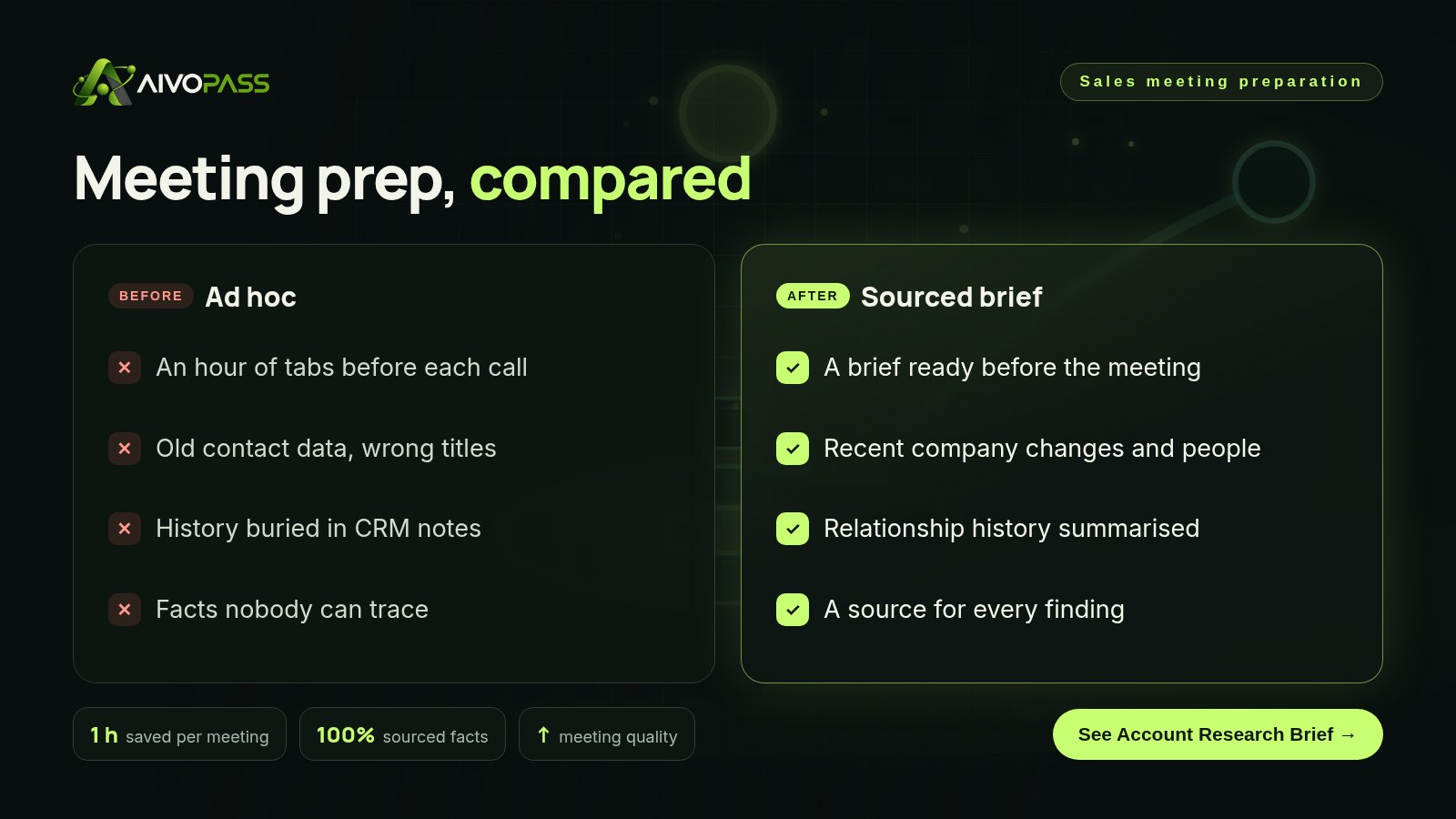
Before and after
| Moment | Without a brief | With Account Research Brief |
|---|---|---|
| Hour before the call | Frantic tab-hopping | Reading a short, ready brief |
| Opening minutes | “So, what is new with you?” | A specific question about a recent change |
| Mid-meeting | Surprised by a new stakeholder | Roles and history already known |
| After the meeting | Notes from memory | Brief plus outcomes in one place |
Who it is for
Sales reps with a full calendar
A Toronto rep with six meetings a day cannot research each one manually. A brief per meeting keeps every conversation sharp.
Account managers
An account manager in Calgary handling renewals and reviews needs relationship history at hand, not buried in years of CRM notes.
Consultants and advisers
A Halifax consultant meeting new prospects each week can walk in knowing the company’s latest changes and the right questions to ask.
Results to expect
These figures are typical estimates, not guarantees. Time saved depends on how you prepare today and how many meetings you have.
A 15-minute prep routine
- Minute 1–5: read the brief: what changed, who is attending, what the history says.
- Minute 6–8: click the sources for anything you plan to mention out loud.
- Minute 9–11: pick the two open questions you most need answered.
- Minute 12–13: write the one outcome you want from this meeting.
- Minute 14–15: note one thing you can offer: an idea, an introduction or an answer.
Red flags in research
- A “fact” with no source attached.
- Titles copied from a database that may be years old.
- News that is about a different company with a similar name.
- History that ignores the last complaint or support issue.
- A brief so long that nobody reads it.
Safety and control
- Read-only research: the agent does not email anyone or change your CRM.
- Only the account you name is researched.
- Every finding is sourced so you can verify it.
- You can revoke CRM access at any time.
How setup works
- Choose Account Research Brief and check out securely.
- Tell us which CRM you use and the kind of meetings you prepare for.
- We connect your CRM and test with one real account.
- Go live: request a brief by naming the account before any meeting.
Related agents
Build full account plans, send follow-ups after the call or prepare a business review deck. Browse all sales AI agents or read more sales guides.
The bottom line
Manual research is thorough but slow, data tools are quick but shallow. Good sales meeting preparation needs both recent context and your own history, with sources you can trust. Account Research Brief delivers exactly that, in a few minutes of reading.
Get Account Research Brief Company changes · Key people · Every fact sourced
Frequently asked questions
How long should sales meeting preparation take?
For a routine meeting, 10 to 15 minutes of reading a good brief is usually enough. Strategic renewals or first meetings with large accounts deserve more, but the research itself should not eat your whole morning.
Are sales data tools enough on their own?
They are useful for contact details and firmographics, but they rarely include recent context, your own relationship history or the questions that matter for this specific meeting.
How does Account Research Brief avoid made-up facts?
Every finding in the brief comes with its source, either a public page or a record in your CRM, so you can check anything before you repeat it in a meeting.
What does it need to work?
Your CRM and the name of the account. It reads only what it needs to build the brief.
Who is it for?
Sales reps, account managers and consultants who walk into many meetings each week and want to be properly prepared for each one.
See Account Research Brief in action.
Researches one account before a meeting, deal review or account plan: company changes, key people, relationship history, open questions and sources for every finding.
We are the people who set up, connect and support AivoPass agents for businesses across Canada and beyond. Every guide is written from real setup work, reviewed by our specialists and updated when an agent changes.
- ✓ Done-for-you setup
- ✓ You approve every important action
- ✓ Secure PayPal checkout
- ✓ Built for Canadian businesses


