
Lead Response Time: Why Speed Wins Deals and How to Reply Faster
When a lead fills in your form, they are often contacting your competitors too. Here is why lead response time matters, how to measure it and a simple system to reply to every inbound lead faster.
 AivoPass Editorial TeamReviewed by our agent setup specialists
Updated
Reading time4 min

Lead response time is how long it takes your team to reply after a prospect fills in a form, calls or sends an inquiry. Faster replies usually mean more meetings, because interest is highest right after the inquiry. Lead Pipeline Desk scores every inbound lead, merges duplicates, assigns an owner and flags any lead left waiting.
A prospect fills in your contact form at 10:05. By 10:20 they have filled in two more on competitors’ sites. Whoever replies first, with something useful, usually gets the meeting. That is why lead response time is one of the simplest numbers to improve and one of the most valuable.
This guide explains how to measure it, what slows teams down and a practical speed-to-lead routine. It also shows how Lead Pipeline Desk scores, de-duplicates and assigns every inbound lead so nothing waits.
See Lead Pipeline Desk Done-for-you setup · You approve every action
What is lead response time?
Lead response time is the gap between a prospect’s inquiry and your team’s first meaningful reply. It matters because interest is highest right after someone reaches out; every hour of silence gives their attention to someone else.
How to measure it
- Median response time: the typical wait, less distorted than an average.
- Slowest ten percent: where the real losses hide.
- By source: website form, events, referrals, ads.
- By hour and day: evenings and Monday mornings are often the weak spots.
Five things that slow teams down
- No owner: everyone assumes someone else will reply.
- Duplicates: the same person appears twice and gets two replies, or none.
- After-hours leads: inquiries at night sit until the next afternoon.
- Unclear priority: a hot demo request waits behind newsletter sign-ups.
- Manual copy-paste: leads move by hand from forms to the CRM.
How Lead Pipeline Desk works
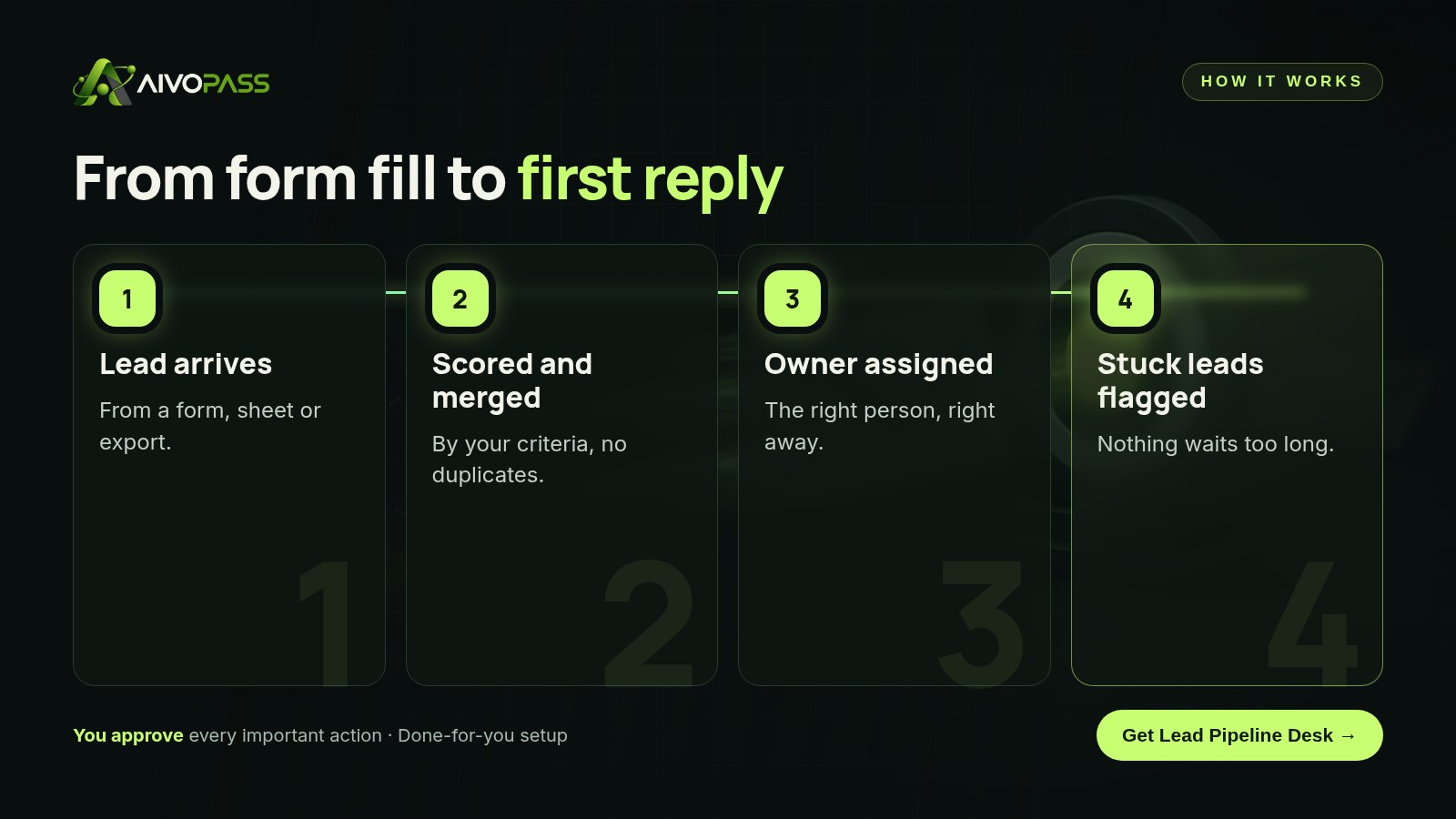
- Lead scoring by your criteria, so urgent leads stand out.
- Duplicate merging before anyone replies.
- Owner assignment the moment a lead arrives.
- Stuck-lead alerts when a lead waits too long.
Response-time targets by lead type
| Lead type | Intent | Suggested target |
|---|---|---|
| Demo or quote request | High | Within the same business hour |
| Contact form question | Medium to high | Same business day |
| Event or webinar attendee | Medium | Within one business day |
| Content download | Lower | Within two business days, with useful follow-up |
Before and after
| Moment | Shared inbox | With Lead Pipeline Desk |
|---|---|---|
| Lead arrives | Sits until someone notices | Scored and assigned |
| Duplicate inquiry | Two reps reply, or nobody | Merged into one lead |
| Hot lead | Same queue as everything else | Flagged as a priority |
| Lead left waiting | Discovered in the monthly review | Alert the same day |

Who it is for
Marketing teams
A marketing lead in Toronto proves that campaign leads are followed up, not lost between teams.
Sales teams
A Vancouver sales team knows exactly whose lead is whose, from the moment it arrives.
Service businesses
A home services company in Calgary answers quote requests while homeowners are still comparing options.
Results to expect
These figures are typical estimates, not guarantees. Results depend on lead volume, team capacity and how quickly owners act.
Example: a Calgary renovation company
A renovation company received quote requests through its website, a home show and referrals. Leads landed in a shared inbox, and the slowest ones waited several days. With Lead Pipeline Desk, each request was scored by project type and location, assigned to the right estimator and flagged if it had no reply by the afternoon. Duplicate requests from the same homeowner were merged. Within weeks, quote requests were answered on the same day and more of them turned into site visits.
A simple speed-to-lead routine
- Check flagged leads first thing in the morning and right after lunch.
- Reply to high-intent leads with a specific next step, not a brochure.
- If you cannot help, say so quickly and point them somewhere useful.
- Review the slowest leads every Friday and fix the cause.
The Friday review is where the routine pays off. If the slowest leads all came in on Sunday evenings, add a Monday-morning check. If they all came from one event, give that source a dedicated owner. Small fixes like these steadily pull your response time down without asking anyone on the team to work longer hours or check their phone at midnight.
Safety and control
- It never sends messages to leads without you.
- Minimum access: your CRM or spreadsheet.
- You set the scoring criteria and owners.
- Revoke access at any time.
Lead Pipeline Desk vs alternatives
| Option | Speed | Duplicates handled | Your effort |
|---|---|---|---|
| Shared inbox | Depends on who is watching | No | Constant checking |
| Rigid CRM rules | Fast, but blind to context | Partly | Setup and upkeep |
| Lead Pipeline Desk | Scored and assigned on arrival | Yes, merged | Act on alerts |
How setup works
- Choose Lead Pipeline Desk and check out securely.
- Share your lead sources, scoring criteria and owners.
- We connect your CRM or sheet and test with real leads.
- Go live: every lead scored, owned and followed up.
Related agents
Build registration pages for events, find ideal prospects or turn sales calls into follow-ups. Browse all marketing AI agents or read more marketing guides.
The bottom line
Lead response time is often the easiest win in your whole funnel. Lead Pipeline Desk makes sure every inbound lead is scored, owned and followed up, so you reply while the prospect is still interested.
Get Lead Pipeline Desk Lead scoring · Owners assigned · Stuck-lead alerts
Frequently asked questions
What is a good lead response time?
As fast as you can manage for high-intent leads such as demo or quote requests, ideally within the same business hour. Lower-intent leads, such as content downloads, can follow within a day.
How do I measure lead response time?
Record when each lead arrives and when the first human reply goes out. Track the median, the slowest ten percent, and break it down by lead source and time of day.
Why are inbound leads answered slowly?
Usually because nobody owns the lead, duplicates cause confusion, leads arrive after hours or the team cannot tell which leads are urgent.
Does Lead Pipeline Desk reply to leads for me?
No. It scores, merges, assigns and flags leads so your team can reply faster. It never sends anything without you.
What does it work with?
Your CRM, a spreadsheet, an export or even a pasted list of leads.
See Lead Pipeline Desk in action.
Scores inbound leads, merges duplicates, assigns an owner and flags anything stuck. Works from a CRM export, sheet or paste and never sends without you.
We are the people who set up, connect and support AivoPass agents for businesses across Canada and beyond. Every guide is written from real setup work, reviewed by our specialists and updated when an agent changes.
- ✓ Done-for-you setup
- ✓ You approve every important action
- ✓ Secure PayPal checkout
- ✓ Built for Canadian businesses


