
How to Write a Positioning Statement (Template and Examples)
A positioning statement is the one paragraph that keeps all your marketing pointing in the same direction. Here is how to write a positioning statement with a simple template and real-world examples.
 AivoPass Editorial TeamReviewed by our agent setup specialists
Updated
Reading time4 min

A positioning statement is an internal sentence that defines who your product is for, the need it meets, the category it belongs to, the main benefit and why buyers should believe it. Write it with a five-part template, test it with customers, then turn it into copy. Product Marketer studies your product and competitors and writes positioning and copy for you.
If your homepage, ads and sales emails each describe your product a little differently, the problem is not the copy. It is missing positioning. Learning how to write a positioning statement gives your whole team one clear answer to the question “who is this for, and why us?”
This guide walks through a five-part template, worked examples for three types of business and a quick way to test your statement. It also shows how Product Marketer studies your product and competitors to write positioning and copy that stands out.
See Product Marketer Done-for-you setup · You approve every action
What is a positioning statement?
A positioning statement is a short internal description of the place your product should hold in a buyer’s mind: who it is for, what need it meets, what category it competes in, its most important benefit and why that claim is believable. It is a compass for your marketing, not a slogan.
The five-part template
- Target customer: the specific group you serve best.
- Need: the problem or goal they care about.
- Category: the type of product buyers compare you with.
- Key benefit: the single most important result you deliver.
- Proof and difference: what you do that the main alternative does not, and why buyers should believe it.
For [target customer] who [need], is a [category] that [key benefit]. Unlike [main alternative], we [point of difference], because [proof].
Worked examples
| Business | Generic message | Positioning statement |
|---|---|---|
| Scheduling software | The best scheduling tool for everyone | For multi-location clinics that lose time to no-shows, a booking system that fills cancelled slots from a waitlist, unlike basic calendars, because it confirms by text in English and French |
| Bookkeeping firm | Quality bookkeeping services | For owner-led trades businesses that hate paperwork, monthly bookkeeping that is done from photos of receipts, unlike year-end accountants, because a named bookkeeper checks in every month |
| Local bakery | Fresh bread and pastries | For offices that want a better morning meeting, a catering bakery that delivers before 8 a.m., unlike grocery platters, because everything is baked the same night |
How Product Marketer helps
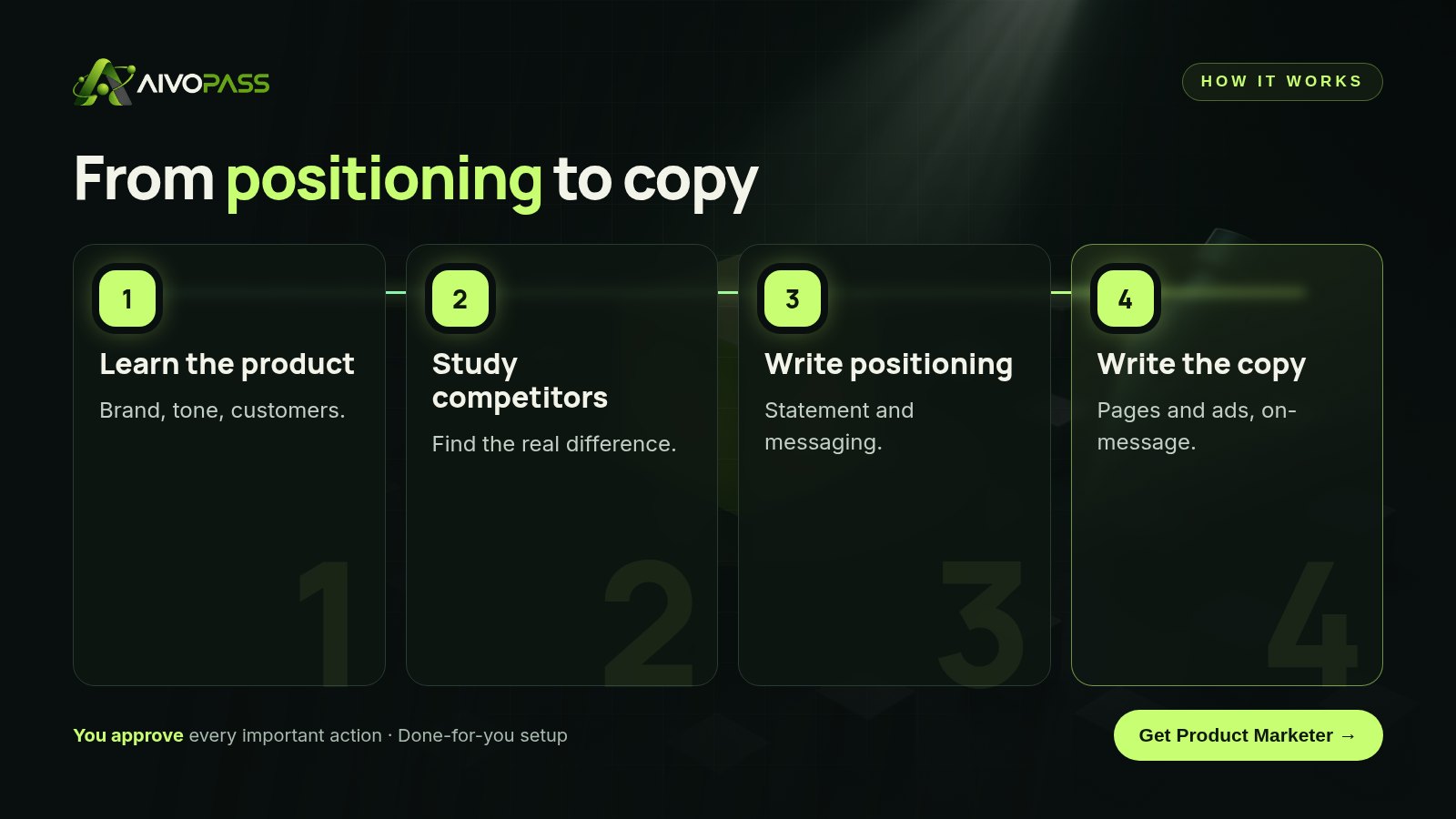
- Positioning and messaging framework built from your product and customers.
- Competitor-aware differentiation that finds what truly sets you apart.
- Landing page and ad copy that follows the positioning.
- Consistent brand voice across every channel.
Before and after
| Area | Without clear positioning | With Product Marketer |
|---|---|---|
| Message | Different on every page | One clear message across channels |
| Difference | Generic claims | Specific, competitor-aware |
| Copy writing | Starts from scratch each time | Built on a shared framework |
| Strategy time | Weeks of workshops | About two weeks of strategy work saved, typical estimate |

How to test your statement
- Read it to three customers. Do they say “yes, that is why I bought”?
- Swap in a competitor’s name. If it still works, it is not specific enough.
- Check the proof. Can you back every claim with a fact?
- Try a headline. Write a homepage headline from it in one line.
- Ask your team. Sales and support should recognise it immediately.
Who it is for
Startups
A Montreal startup with a strong product kept losing deals to bigger names. Sharper positioning focused its message on the one group of customers it served better than anyone.
SaaS companies
A Toronto SaaS company had five product pages written by five people. A shared framework brought them into one voice.
Product businesses
A Vancouver maker of outdoor gear used competitor research to find a point of difference worth leading with in ads.
Results to expect
These figures are typical estimates, not guarantees. Results depend on your market, product and how consistently the positioning is used.
From statement to copy
Once the statement is agreed, turn each part into copy. The target customer and need become your headline, the key benefit becomes your subheadline, the proof becomes bullet points and testimonials, and the point of difference becomes the comparison section. Use the same building blocks for ads and sales emails so every channel tells the same story.
Safety and control
- You review and approve all positioning and copy before use.
- Competitor research uses public information only.
- No claims without facts you can support.
- You can pause the agent or revoke access at any time.
Product Marketer vs alternatives
| Option | Competitor research | Copy included | Speed |
|---|---|---|---|
| Brainstorming alone | Limited | You write it | Slow |
| Branding agency | Yes | Often extra | Weeks to months |
| Freelance copywriter | Sometimes | Yes | Medium |
| Product Marketer | Yes | Yes, pages and ads | Fast, reviewed by you |
How setup works
- Choose Product Marketer and check out securely.
- Share your product information, website and competitor list.
- We review the draft positioning and messaging with you.
- Go live: landing page and ad copy that follow your positioning.
Related agents
Turn your positioning into proof stories, make your copy sound natural or check how visible you are in AI search answers. Browse all marketing AI agents or read more marketing guides.
The bottom line
Knowing how to write a positioning statement gives every page, ad and email the same clear direction. Use the template, test it with real customers, then let Product Marketer sharpen the difference and write the copy that brings it to life.
Get Product Marketer Positioning · Competitor-aware · Copy for pages and ads
Frequently asked questions
What is a positioning statement?
It is a short internal statement that defines who your product is for, what need it meets, what category it belongs to, its main benefit and the proof behind it. It guides your copy rather than appearing word for word in ads.
What is a simple positioning statement template?
For [target customer] who [need or problem], [product] is a [category] that [key benefit]. Unlike [main alternative], we [point of difference], because [proof].
How is positioning different from a tagline?
Positioning is the strategy: who you serve and why you are different. A tagline is one short, public expression of that strategy. Write the positioning first.
What does Product Marketer do?
It learns your product, brand, tone and positioning, studies competitors to sharpen what makes you different and writes copy for landing pages and ads that you review before use.
Who is it for?
Startups, SaaS and product companies that want clear positioning and consistent copy across channels.
See Product Marketer in action.
Learns your product, brand, tone and positioning, studies competitors to sharpen what makes you different, and writes copy for landing pages and ads.
We are the people who set up, connect and support AivoPass agents for businesses across Canada and beyond. Every guide is written from real setup work, reviewed by our specialists and updated when an agent changes.
- ✓ Done-for-you setup
- ✓ You approve every important action
- ✓ Secure PayPal checkout
- ✓ Built for Canadian businesses


