
How to Find Passive Candidates: A Practical Sourcing Guide for Small Teams
The best people for your role are often not applying anywhere. Here is how to find passive candidates, judge fit fairly and build a ranked shortlist every week without a recruiting team.
 AivoPass Editorial TeamReviewed by our agent setup specialists
Updated
Reading time4 min

Passive candidates are skilled people who are not actively job hunting but would consider the right role. To find them, search public profiles against clear criteria, remove people already in your pipeline and reach out personally. Talent Finder does the search each week and gives you a ranked shortlist with a short fit reason for each candidate.
Post a job ad and you mostly hear from people who are actively looking. That is fine for some roles, but for skilled positions the strongest people are often busy doing great work somewhere else. Knowing how to find passive candidates gives small teams access to talent their job ads never reach.
This guide covers where passive candidates are, how to judge fit fairly from public information and a weekly routine that fits into a busy hiring manager’s calendar. It also shows how Talent Finder builds a ranked shortlist for you every week.
See Talent Finder Done-for-you setup · You approve every action
What is a passive candidate?
A passive candidate is a qualified professional who is not actively applying for jobs but would consider a move for the right role, team or growth opportunity. They are usually employed, often well regarded and rarely respond to generic messages.
Where passive candidates are, by role
| Role type | Where to look | Good fit signal |
|---|---|---|
| Software and data | Public code projects, technical blogs, meetup talks | Recent work in your stack |
| Sales and account management | Professional profiles, industry associations | Experience selling to your customer type |
| Design and marketing | Portfolios, case studies, award lists | Work similar to your brand and market |
| Skilled trades and operations | Trade associations, certification lists, referrals | Relevant certifications and local experience |
| Finance and admin | Professional bodies, profiles, alumni groups | Industry and software experience |
How Talent Finder works
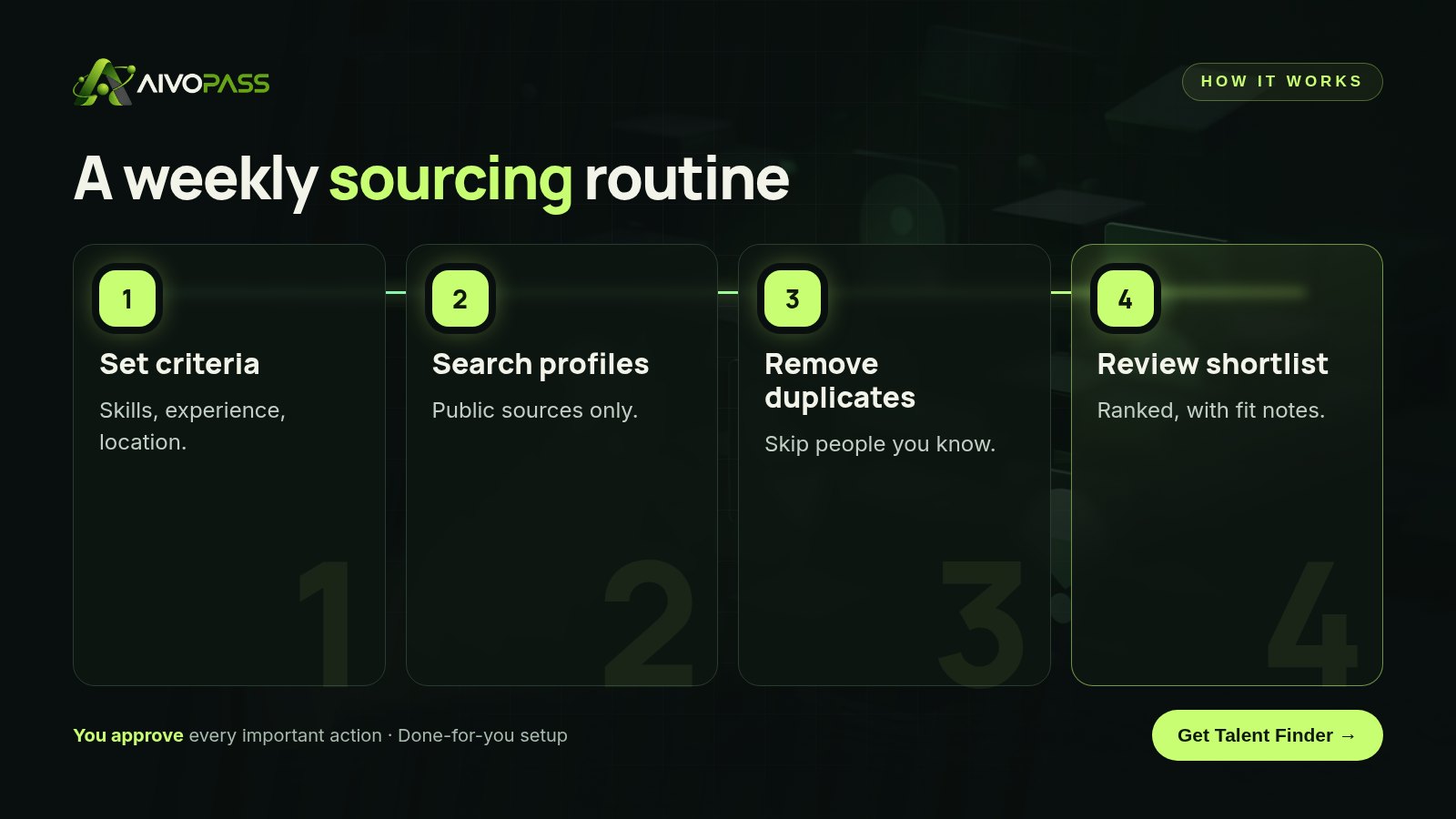
- Searches public profiles by your criteria: skills, experience, location and more.
- Removes people already in your pipeline, so you only see new names.
- Adds a short fit summary explaining why each person matches.
- Delivers a ranked shortlist every week while the role is open.
Before and after
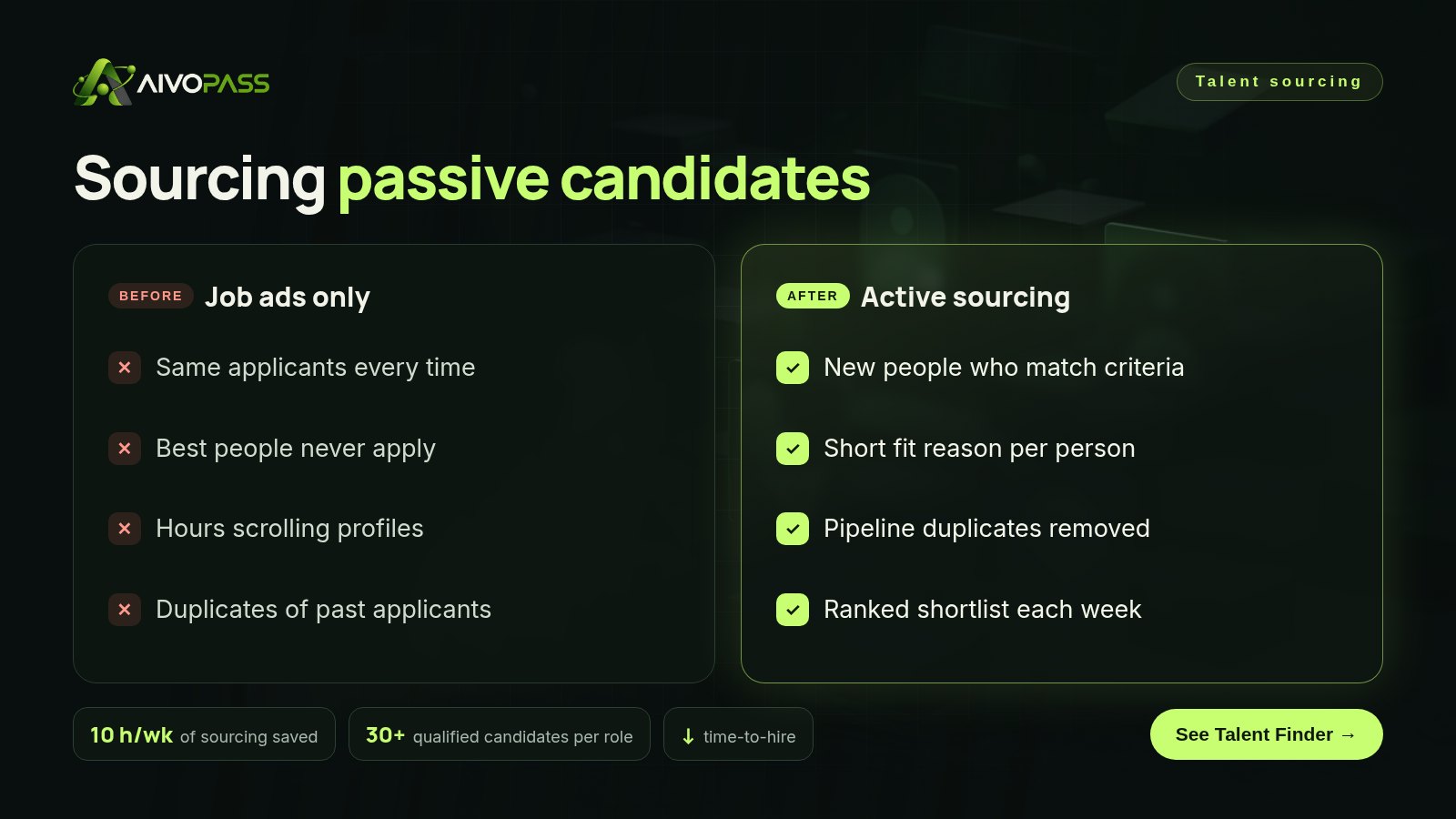
| Area | Job ads only | With Talent Finder |
|---|---|---|
| Candidate pool | Whoever applies | People who match your criteria |
| Duplicates | Same names resurface | Existing applicants removed |
| Fit assessment | Long profile reading | Short fit reason per person |
| Your time | Many hours of searching | About ten hours a week saved, typical estimate |
Who it is for
Hiring managers
An engineering manager in Vancouver needed a senior developer with a specific background. The ads brought volume but few matches; a weekly shortlist brought fewer, better names.
Recruiters
An independent recruiter in Calgary fills roles for several energy services clients. Starting each week with a ranked list leaves more time for conversations.
Founders
A Halifax founder hiring a first sales lead has no recruiting team. The shortlist gives her a practical starting point for personal outreach.
Results to expect
These figures are typical estimates, not guarantees. Results depend on the role, location and how specific your criteria are.
How to judge fit from a public profile
A profile is a starting point, not a verdict. Look for evidence of the work itself rather than titles alone: projects that resemble yours, the size of teams they have worked in, how long they stayed in recent roles and whether their location or time zone suits the job. Write down two or three must-have criteria and two or three nice-to-haves before you start, and apply them the same way to every person. That keeps the shortlist fair and makes it easy to explain why someone made the list.
An example: a Montreal software company looking for a bilingual customer success lead set three must-haves (experience with business customers, French and English, at least two years in a similar role). The weekly shortlist explained, in one line per person, which of those criteria each candidate met, so the hiring manager could pick the five most promising names in minutes.
Respectful outreach rules
- Be personal. Mention the specific work that caught your attention.
- Be brief. Three or four sentences, with a clear reason you reached out.
- Offer a low-pressure next step, such as a short exploratory call.
- Respect a no. One polite follow-up at most.
- Judge on skills and experience only. Keep criteria job-related and consistent with Canadian human rights and privacy expectations.
A weekly sourcing routine
- Monday: review the ranked shortlist and mark the top names.
- Tuesday: send a few personal messages.
- Wednesday to Thursday: hold short exploratory calls.
- Friday: refine the criteria based on what you learned.
Safety and control
- Uses public information only.
- You decide who to contact; nothing is sent for you.
- Your applicant list is used only to remove duplicates.
- You can pause the agent or revoke access at any time.
Talent Finder vs alternatives
| Option | Reaches passive talent | Fit explained | Effort for you |
|---|---|---|---|
| Job ads | Rarely | No | Medium, screening applicants |
| Recruitment agency | Yes | Yes | Low, but a large fee per hire |
| Manual sourcing | Yes | Yes | High |
| Talent Finder | Yes | Yes, short fit summary | Low |
How setup works
- Choose Talent Finder and check out securely.
- Share the role description, criteria and your current applicant list.
- We run the first search and review the shortlist with you.
- Go live: a ranked shortlist arrives every week while the role is open.
Related agents
After sourcing, an interview coordinator can handle scheduling, and an office operations agent can prepare onboarding. Browse all people and HR AI agents or read more hiring guides.
The bottom line
The best person for your role may never see your job ad. Learn how to find passive candidates, reach out personally and respectfully, and let Talent Finder bring you a fresh, ranked shortlist every week.
Get Talent Finder Public profiles · Duplicates removed · Weekly shortlist
Frequently asked questions
What is a passive candidate?
A passive candidate is someone with the skills you need who is not actively applying for jobs but may be open to the right opportunity if approached personally.
Where do you find passive candidates?
On public professional profiles, portfolios, community and industry sites, open-source projects, conference speaker lists and through referrals. The right place depends on the role.
Does Talent Finder contact candidates for me?
No. It finds candidates who match your criteria, removes people already in your applicant system and gives you a ranked shortlist with fit reasons. You decide who to contact and how.
What do I need to provide?
A role description with your criteria and your current applicant list, so people already in your pipeline are skipped.
Who is it for?
Recruiters, hiring managers and founders who want more qualified candidates than job ads bring in.
See Talent Finder in action.
Finds candidates for your open roles that match your criteria and are not already in your applicant system, with a short reason why each one fits.
We are the people who set up, connect and support AivoPass agents for businesses across Canada and beyond. Every guide is written from real setup work, reviewed by our specialists and updated when an agent changes.
- ✓ Done-for-you setup
- ✓ You approve every important action
- ✓ Secure PayPal checkout
- ✓ Built for Canadian businesses


