AI Software Engineer Agent: Faster Fixes, Round-the-Clock Issue Triage and Code You Review First
Bugs do not wait for office hours, and small teams cannot watch production around the clock. An AI software engineer agent triages issues, investigates errors and proposes fixes, then waits for your review before anything ships.
 AivoPass Editorial TeamReviewed by our agent setup specialists
Updated
Reading time4 min

An AI software engineer agent works inside your code repository like an extra developer. It writes and fixes code, sorts incoming issues at any hour, watches production for errors and proposes fixes as pull requests. Nothing ships until a person on your team reviews and approves it, so speed goes up without losing control.
Every software team has a backlog of small bugs nobody has time for, and a nagging worry about what breaks overnight. An AI software engineer agent takes on that steady, unglamorous work: it reads new issues as they arrive, looks into production errors and writes fixes for your team to review. It never ships on its own, but it means far less waits until Monday.
Below we look at how the Software Engineer Agent fits three common kinds of business, then lay out a realistic first 30 days.
See the Software Engineer Agent Done-for-you setup · You approve every action
What is an AI software engineer agent?
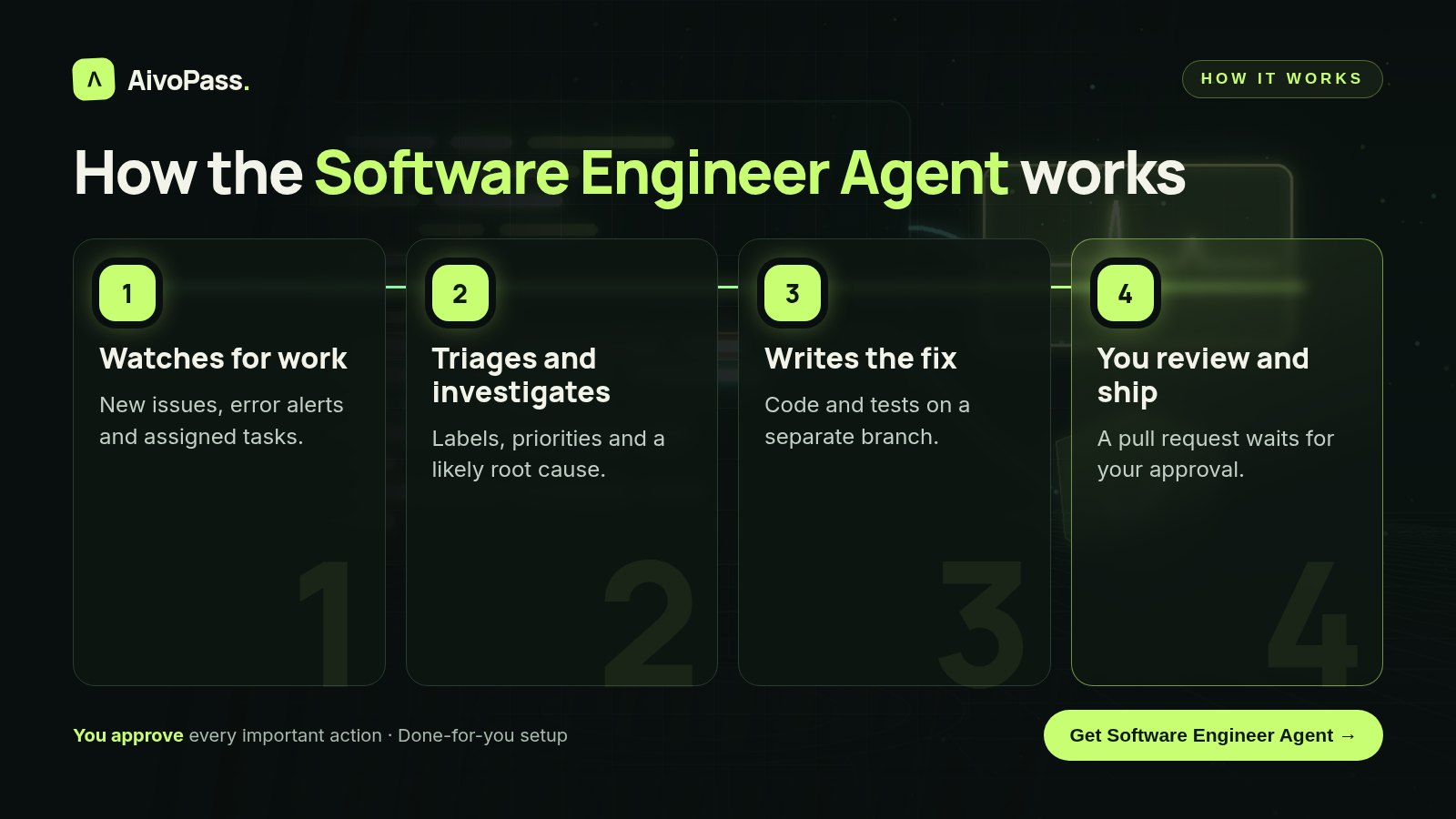
An AI software engineer agent is an assistant that works inside your code repository and issue tracker. It writes and fixes code, triages incoming issues at any hour and monitors production errors. Every change it makes arrives as a pull request that a human reviews before it ships.
Its four everyday jobs
- Writes and fixes code. Small features, bug fixes and tests, written on a separate branch in your project’s style.
- Triages incoming issues. New reports are labelled, given a priority, checked for duplicates and matched with the likely part of the code.
- Watches production errors. When errors spike, it gathers the details and suggests a likely cause.
- Waits for review. Every change comes with a plain-language summary of what changed and why.
Before and after
| Moment | Small team on its own | With the Software Engineer Agent |
|---|---|---|
| A bug report arrives on Saturday | Read on Monday, maybe | Labelled, prioritised and investigated |
| An error spikes overnight | A customer reports it first | Details and a likely cause are ready |
| A small, known bug | Waits for a free sprint | A fix is proposed as a pull request |
| Duplicate issues | Clutter the tracker | Linked and tidied up |
| Developer focus | Split between bugs and features | More time on features and design |

How it fits three kinds of business
A SaaS startup
A five-person software company in Toronto has customers in several time zones. The agent triages overnight issues from European and Asian users, so the team starts each morning with a sorted list and draft fixes instead of a pile of unread reports.
An online store with custom code
A Montreal retailer with a customised store has one part-time developer. The agent watches checkout and product-page errors, writes small fixes and leaves them for the developer to review on their next working day.
A digital agency
A Halifax agency maintains websites and apps for dozens of clients. The agent handles the stream of small maintenance requests across repositories, and developers approve the changes before they reach each client.
What to expect
These figures are typical estimates for teams with an active backlog, not guarantees. Results depend on your codebase, test coverage and how quickly your team reviews pull requests.
Speed is only part of the story. The bigger change for most small teams is peace of mind. When issues are sorted as they arrive and errors are investigated before customers notice, developers can switch off in the evening and start the next day with a clear picture. Reviews also become easier over time, because the agent learns your project conventions from the feedback your team gives on each pull request.
Your first 30 days
- Week 1: connect and observe. We connect your repository and issue tracker. The agent triages new issues and suggests labels, without writing code yet.
- Week 2: small fixes. It starts proposing fixes for low-risk bugs. Your team reviews each one and gives feedback.
- Week 3: production watch. If you use error monitoring, it begins investigating alerts and attaching findings to issues.
- Week 4: widen the scope. With trust built, it takes on small features and test writing, still with review on every change.
Moving step by step lets your team see the quality of the work before handing over more.
Guardrails built in
- Nothing ships without human review and approval.
- It works on separate branches, never directly on your main branch.
- It uses the minimum access needed, and you can revoke it at any time.
- Every action is visible in your repository and issue tracker.
- When it is unsure about a fix, it says so and asks rather than guessing.
AI engineer agent vs other options
| Option | Coverage | Speed on small bugs | Team effort | Best for |
|---|---|---|---|---|
| Current team only | Office hours | Slow when busy | High | Teams with spare capacity |
| On-call rotation | Around the clock | Medium | High (and tiring) | Larger teams |
| Outsourced maintenance | Varies | Medium | Medium (briefing, handover) | Stable, rarely changing code |
| Software Engineer Agent | Around the clock | Fast | Low (reviews only) | Startups and small software teams |
How setup works
- Choose the Software Engineer Agent and check out securely.
- Tell us about your repository, issue tracker and the kinds of work to start with.
- We connect access, run a few test issues and review the results with your team.
- You go live, usually within a week.
Related agents
Pair it with agents that plan work and audit code for an even stronger setup. Explore all AI engineering agents or read more engineering guides.
The bottom line
An AI software engineer agent will not design your product or make your big technical decisions. What it does is keep the small things from piling up: issues sorted at any hour, errors investigated early and fixes ready for review. For a small team, that steady help adds up quickly.
Get the Software Engineer Agent Done-for-you setup · Your team reviews every change
Frequently asked questions
What is an AI software engineer agent?
It is an agent that works in your code repository and issue tracker like an extra developer: it writes and fixes code, sorts new issues, watches production errors and proposes changes for your team to review.
Can it push changes to production without us?
No. Every change is proposed as a pull request on a separate branch. A person on your team reviews and approves it before it is merged or released.
What access does it need?
Access to your code repository and your issue tracker, plus read access to error monitoring if you want production alerts covered. We set the lowest permissions that work, and you can revoke them at any time.
How long until it is useful?
Most teams see their first reviewed fixes within the first week. We connect your tools, start with small issues, and widen the scope as your team gets comfortable with its work.
Does it replace our developers?
No. It takes on the steady flow of small fixes and first-pass triage so your developers can focus on bigger features, design decisions and customers.
See Software Engineer Agent in action.
Writes code, triages issues, monitors production and fixes bugs — working inside your repository and asking for review before anything ships.
We are the people who set up, connect and support AivoPass agents for businesses across Canada and beyond. Every guide is written from real setup work, reviewed by our specialists and updated when an agent changes.
- ✓ Done-for-you setup
- ✓ You approve every important action
- ✓ Secure PayPal checkout
- ✓ Built for Canadian businesses