
How to Edit Your Own Writing: A 4-Pass Method for Clearer Emails, Posts and Documents
You know what you meant, so your brain fills the gaps when you reread. Here is a simple four-pass method to edit your own writing so emails, posts and documents come out clear and confident.
 AivoPass Editorial TeamReviewed by our agent setup specialists
Updated
Reading time4 min
To edit your own writing, use four separate passes: structure (is the main point first?), clarity (shorter sentences, plain words), tone (right for the reader?) and polish (typos, names, numbers). Read it aloud and take a break between drafting and editing. Writing Partner guides a structured draft-and-revise process that keeps your meaning, facts and voice.
You reread your email three times, hit send and spot the mistake a second later. It happens to everyone, because when you read your own words, your brain sees what you meant, not what you wrote. Learning how to edit your own writing is less about talent and more about a method that makes you read like a stranger.
This guide gives you a four-pass editing method, a self-editing checklist, habits to cut and before and after examples. It also shows how Writing Partner guides a structured draft-and-revise process while keeping your meaning, facts and voice.
See Writing Partner Done-for-you setup · You approve every action
What does it mean to edit your own writing?
Editing your own writing means reviewing a draft for structure, clarity, tone and accuracy before anyone else sees it. It is different from proofreading, which only catches typos. Good self-editing changes what the reader understands, not just how the text looks.
The four-pass editing method
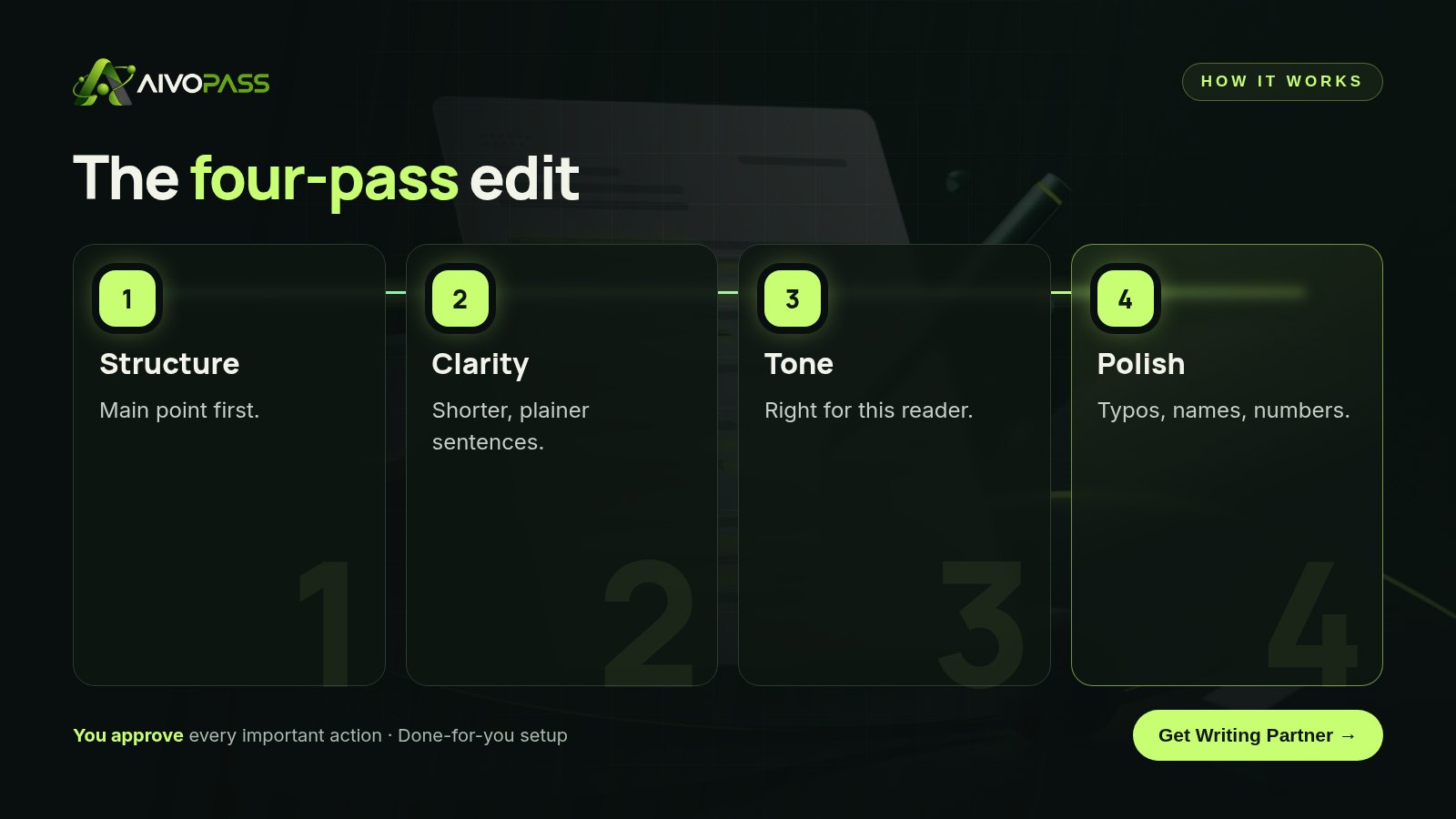
- Structure: is the main point or request in the first two lines? Does each paragraph do one job?
- Clarity: can long sentences be split? Can a plain word replace a fancy one?
- Tone: does it sound right for this reader: a client, a colleague, a stranger?
- Polish: check names, dates, numbers, links and typos last.
How Writing Partner helps
- A structured draft-and-revise process, one step at a time.
- Clearer structure and flow, with the main point up front.
- Keeps your facts and voice, so it still sounds like you.
- Works for any kind of writing, from emails to essays.
Before and after: sentence examples
| Before | After | What changed |
|---|---|---|
| “I just wanted to reach out to see if maybe we could possibly meet.” | “Could we meet on Thursday?” | Filler and hedging cut |
| “The report was reviewed by the team.” | “The team reviewed the report.” | Active voice |
| “We leverage synergies to optimise outcomes.” | “We work together to get better results.” | Jargon replaced |
| “Further to my previous email below…” | “Quick reminder: the form is due Friday.” | Main point first |
Before and after
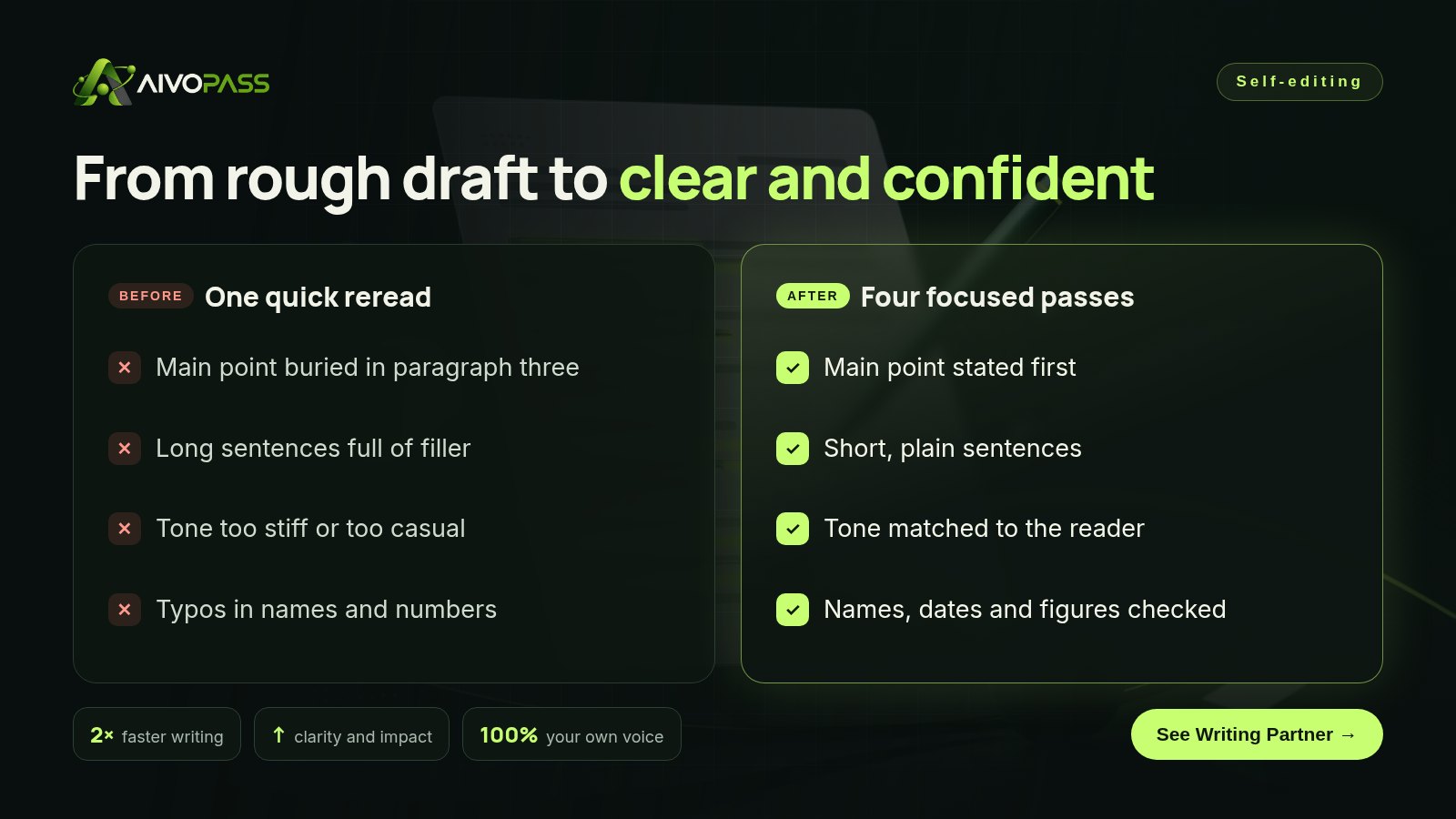
| Moment | One quick reread | With Writing Partner |
|---|---|---|
| Main point | Buried mid-email | Stated first |
| Sentences | Long and padded | Short and plain |
| Tone | Guessed | Checked for the reader |
| Your voice | Lost in heavy rewrites | Kept intact |
Who it is for
Professionals and consultants
A consultant in Halifax writes proposals and client updates every week and wants them sharper without hiring an editor.
Founders
A founder in Calgary writes investor updates and website copy between everything else.
Students and second-language writers
A graduate student in Montreal writes in English as a second language and wants clarity without losing meaning.
Results to expect
These figures are typical estimates, not guarantees. Results depend on the writing task and your starting draft.
Your self-editing checklist
- Main point or request in the first two lines.
- One idea per paragraph.
- Most sentences under about 20 words.
- Filler cut: “just”, “really”, “I think”, “basically”.
- Jargon replaced with plain words.
- Active voice where possible.
- Names, dates, numbers and links double-checked.
- Read aloud once before sending.
- Subject line or headline tells the reader exactly what to expect.
- Ask: what one action should the reader take after reading this?
Two habits that make editing easier
Read it aloud. Your ear catches clumsy rhythm, missing words and overly long sentences that your eyes skip. Sleep on it when you can. Even a short break, a coffee or a walk, lets you return to the draft as a reader instead of the writer. For important documents, leave it overnight.
Example: a Halifax consultant’s proposal
A consultant in Halifax had a twelve-page proposal draft that started with three paragraphs of company history. Working with Writing Partner, she moved the client’s problem and her recommended approach to the first page, split long sentences in the methodology section and softened a few lines that sounded abrupt. Every figure and claim stayed exactly as she wrote it. The final version was three pages shorter, and the client’s first reply quoted her opening summary back to her.
Safety and control
- Works only from the drafts and notes you share.
- Keeps your facts; never invents new claims.
- You accept or reject every suggested change.
- Your writing stays yours.
Writing Partner vs alternatives
| Option | Improves structure | Keeps your voice | Available any time |
|---|---|---|---|
| Spellcheck only | No | Yes | Yes |
| Asking a busy colleague | Sometimes | Usually | Rarely |
| Writing Partner | Yes | Yes | Yes |
How setup works
- Choose Writing Partner and check out securely.
- Tell us what you usually write and who reads it.
- We revise your first piece together and agree the process.
- Go live: share a draft or notes, revise with a partner.
Related agents
Make AI-sounding copy natural, gather customer proof or track brand mentions. Browse all marketing AI agents or read more marketing guides.
The bottom line
Good writers are mostly good editors. Edit in four passes, read aloud and step away before the final check. Writing Partner gives you that structure every time, so your writing gets clearer while still sounding like you.
Get Writing Partner Structured revision · Keeps your facts · 100% your voice
Frequently asked questions
Why is it hard to edit your own writing?
You know what you meant, so your brain fills in missing words and skips over unclear sentences. Time away from the draft and reading aloud help you see it as a reader would.
What is the best way to self-edit?
Edit in separate passes: first structure, then clarity, then tone, then polish. Trying to fix everything at once usually means fixing only typos.
Will Writing Partner change my voice?
No. It keeps your meaning, facts and voice, and helps you revise rather than replacing your writing.
What kinds of writing does it help with?
Emails, essays, documents, articles, proposals and posts: any kind of writing, from your drafts or notes.
Can it help if English is my second language?
Yes. It helps with clarity and flow while keeping what you mean, which is useful for anyone writing in a second language.
See Writing Partner in action.
Helps you draft and revise essays, emails, documents and articles with a structured revision process that keeps your meaning, facts and voice.
We are the people who set up, connect and support AivoPass agents for businesses across Canada and beyond. Every guide is written from real setup work, reviewed by our specialists and updated when an agent changes.
- ✓ Done-for-you setup
- ✓ You approve every important action
- ✓ Secure PayPal checkout
- ✓ Built for Canadian businesses


